Facts
Claims grounded in the source draft's public-source apparatus.
Claims grounded in the source draft's public-source apparatus.
Reasoned interpretation, intentionally marked as arguable.
Proposed civic action, separated from claim and interpretation.
Shield -> armed forces, intelligence, alliances, emergency services.
Nervous system -> cyber, telecoms, payments, data, logistics.
Bloodstream -> energy, food, water, transport, health, money.
Social fabric -> trust, skill, shared reality and neighbours.
This is a calm, practical field guide to Britain’s new security age — written for ordinary people, not defence insiders. It exists because the gap between what the government now says (“whole-of-society resilience”) and what a normal person is actually supposed to do about it is enormous, and almost nobody is translating. The whole argument fits in one line: if you want peace, it helps to be hard to frighten, hard to divide, and hard to switch off.
Who this is for — the student who assumes none of this is for them; the engineer who flinches at the word “defence”; the founder who hasn’t noticed that resilience is a market the size of a continent; the migrant who wants to contribute and doesn’t know if they’re allowed; and the parent, nurse, driver, or neighbour who is the social fabric without ever having been told so.
If you do only three things: Understand — read one official source this month as a citizen, not an analyst. Prepare — first aid, backups, and knowing who on your street would struggle on a bad day (the goal is to be less annoying to rescue). Serve — pick one route from the spectrum in Chapter 4 and check its official eligibility page.
And if you have more than ten minutes: start at the Author’s Note. It explains who’s writing this, and why a Russian is the one holding the pen.
Let me get the obvious objection out of the way before you do.
I am a Russian, writing a book about how Britain might get ready for the possibility of war with Russia.
I know. If I were you, I’d have raised an eyebrow too. It has the structural elegance of a fox publishing a henhouse-security newsletter. So let me be precise about what this is, because the precision is the whole point.
This is not a Russian telling Britain how to be Britain. I’d be terrible at that. I still hesitate over whether “cheers” to a stranger is friendly or presumptuous; it took me a year to learn that “not bad” is, here, a standing ovation. I am not here to explain your island to you.
I’m here because I left the country that is now the threat, I chose this one, and people who choose a place tend to notice what the people born into it stopped seeing years ago. The fish is the last to discover water. I’m the slightly-too-keen newcomer at the lake going do you realise how much water you have?
I should also be honest about the discomfort, not paper over it. A Russian-born author writing on British readiness has to be careful, and I am. There is a Foreign Influence Registration Scheme — it came into force on 1 July 2025, under the National Security Act 2023 — and there are good reasons for it; this book takes no view on anyone’s personal legal position, including mine, and points you to the official guidance instead of pretending to be your lawyer. What I can tell you is the spirit of the thing: everything here is built from public sources, written in the open, and aimed at making this country harder to frighten — not at speaking for anyone but myself.
A word on what I bring that isn’t a passport. I spend my professional life as a founder and investor looking at non-consuming markets — the useful things that don’t happen yet because nobody has framed them as worth doing. I’m trained to look at a system and ask where the wasted capacity is. That, more than any war story, is the lens of this book. I think Britain has enormous wasted capacity for resilience sitting in plain sight — in people, skills, and habits currently filed under “not my department” — and I find that exciting rather than ominous.
I’m a pacifist, by the way. Not the bumper-sticker kind — the kind that grew up close enough to power-without-conscience to take it personally. I don’t want Britain to admire force. I want it to be so calmly, boringly difficult to attack that nobody sensible tries. If that sounds like a contradiction, the first chapter is for you.
— Slava Solodkiy.cv, Shoreditch
I will never smuggle an opinion past you dressed as a fact. To keep that promise, three labels recur throughout:
And a confidence tag on the evidence:
[Strongly evidenced] — official documents or multiple reliable public sources.
[Moderately evidenced] — credible, but handle with care.
[Weakly inferred] — a useful hypothesis, not settled truth.
A book about national security that played fast and loose with what’s true would be its own small act of sabotage. This apparatus is the porcupine’s first quill.
There is also one editorial test every page had to pass. I call it the Sea Test, after a line usually pinned on Saint-Exupéry: if you want people to build a ship, don’t hand out tools and assign tasks — teach them to long for the sea. Before any page earned its place I asked: does this make a thoughtful reader more willing and able to build something useful — or is it just another page about nails? Pages that were only nails were cut.
Finally, a map. Whenever you feel lost, picture national readiness as four layers — we’ll use them throughout:
The shield — armed forces, intelligence, alliances, police, borders, emergency services.
The nervous system — cyber, telecoms, payments, data, logistics; what a society thinks with.
The bloodstream — energy, food, water, transport, health, money; the flows you notice only when they stop.
The social fabric — trust, skill, shared reality, the willingness of neighbours to be neighbours.
Most public argument fixates on layer one, because it has tanks in it. Most modern trouble starts in the other three.
It is not a war manual, a panic button, or operational advice. There are no weapons instructions, no tactics, nothing your worst enemy couldn’t already read on a government website. It will not tell you the end is near, that you should be afraid, or that buying a generator makes you a patriot. It is the opposite of a fear product. If at any point it reads as if it’s enjoying the danger, I’ve failed, and you should email me.
This first part is about the mind, not the kit. Before a single practical step makes sense, the frame has to shift: from fear to readiness, from spectator to participant, from “defence is someone else’s department” to “the front line runs through ordinary life.”
You’ll meet the three metaphors the rest of the book leans on — the porcupine, the sea, the cheese hill — and the four-layer map you’ll use to read everything that follows.
By the end of Part I you’ll be able to say, in one sentence, what readiness is and why a pacifist can believe in it — and to spot which “layer” any news story is really about.
You’ve met me in the Author’s Note, so I won’t run the introductions again — except for one line, because the whole book balances on it. My vantage point here is not expertise from above; it is attention from the side: the immigrant’s slightly irritating habit of being moved by the things the natives have long since stopped noticing.
With that established, here is the argument.
Here is the argument of the whole book, and it fits in a single line:
If you want peace, it helps to be hard to frighten, hard to divide, and hard to switch off.
Everything else — all ten chapters, the strategy documents, the drones, the recruitment ads, the prisoners learning to code — is detail and evidence in service of that one sentence. If you read no further, you already have the thesis. The rest of the book is just me trying to earn it.
Notice what the sentence does not say. It does not say “be strong” in the chest-beating sense. It does not say “be afraid.” It does not say “prepare for the end.” It describes three properties of a society — hard to frighten, hard to divide, hard to switch off — none of which require a single extra tank, and all of which are mostly built by civilians. Hold that thought; we’ll be coming back to it from six directions.
There’s a line usually attributed to Antoine de Saint-Exupéry: if you want people to build a ship, don’t drum up the workers, assign the tasks, and distribute the timber. Teach them to long for the sea.
It is the single best diagnosis I know of why almost all official communication about security bounces off the public like rain off a waxed jacket.
The state gives you a shipyard. It gives you acronyms, strategy documents, application portals, preparedness checklists, procurement diagrams, recruitment slogans set in a font that was focus-grouped into submission, and a campaign website featuring a thoughtful young person gazing at a horizon you cannot see. Some of that machinery is genuinely necessary — you cannot run a navy on inspiration, and a checklist has saved more lives than any speech. But none of it is the sea. None of it reaches the part of a human being that actually decides, on a wet Tuesday, what is worth caring about.
The sea is the thing being protected. And here is the part the posters can never quite say out loud, because it sounds too soft for a government and too sincere for an advert: for Britain, the sea is almost entirely ordinary.
It is the bus that turns up. The hospital that holds its shape on a bad night. The card payment that simply clears, in under a second, without you thinking about the four institutions and the undersea cable that had to cooperate to make it happen. It is the port that keeps breathing, the pharmacy that has your prescription, the school that knows what to do when the power goes, the water that is safe because thousands of unglamorous people made it safe this morning and will again tomorrow. It is the group chat that organises the street when it floods. It is the simple, civilisational miracle of a society that works — and the quiet, almost arrogant confidence that it will keep working even while someone is actively trying to make it stop.
That confidence is the actual asset. Armies exist, in the end, to protect the conditions under which ordinary life can afford to take itself for granted. Readiness is not the love of war. It is the refusal to let war set the terms of everyday life.
So when I say this is not a fear book, I mean something specific. Fear stares at the storm. This book is going to keep pointing, stubbornly, at the harbour — because the harbour is the reason anyone bothers with the storm at all.
Here is the problem with the comfortable mental image of “defence.” Most people picture the front line as a place: a border, a trench, a grey sea with grey ships on it, somewhere far away and staffed by professionals. For most of modern history that picture was roughly right, and its rightness bought the rest of us a kind of permission not to think about it.
The picture is now wrong, and its wrongness is the reason for this entire book. Let me show you with two true stories rather than an argument, because arguments persuade the head and stories persuade the part of you that changes its behaviour.
In May 2017, a piece of malware called WannaCry swept through computer systems around the world. In Britain it hit the National Health Service. Suddenly hospitals could not access patient records. Appointments were cancelled, ambulances diverted, operations postponed. No one fired a shot. No border was crossed. The “front line,” for a few frightening days, was a server room and an A&E reception desk — and the casualties were ordinary people who simply needed care and found the system frozen.
Now look out to sea — specifically, the floor of the Baltic.
Read those two stories as a citizen, not an analyst, and a single uncomfortable insight falls out: the things that can be attacked are no longer only soldiers and borders. They are the cables, the hospitals, the payment rails, the power connectors, the trust — the invisible scaffolding of normal life. An anchor dragged along a seabed is not a battle in any sense your grandfather would recognise. But it is, unmistakably, a way of testing whether a society can be made to flinch.
This is not said to frighten you. It is said to relocate you. Because once you understand that the front line now runs through server rooms, substations, supply chains, and group chats, you also understand the good news hiding inside the bad: if the front line runs through ordinary life, then ordinary people are no longer spectators to security. They are, whether they volunteered or not, part of the perimeter. And a perimeter that knows it’s a perimeter is a very different thing from one that thinks security happens somewhere else, to someone else, for a salary.
Here is where I lose a certain kind of reader, so let me plant my flag firmly and in daylight.
I am a pacifist. Not the bumper-sticker kind — the kind that grew up close enough to power-without-conscience to take it personally, and who therefore has no romantic illusions about force whatsoever. I do not want Britain to admire strength. I want Britain to be so calmly, so boringly, so comprehensively difficult to attack that the question of attacking it never makes it past the first meeting.
The animal for this is not the lion. Lions are militarism: the mane, the roar, the brochure cover, force as identity and spectacle. Lions are what you get when a society starts to enjoy its own power, which is the precise moment it becomes dangerous to itself and others.
The animal is the porcupine.
A porcupine attacks nobody. It has no designs on your territory, no expansionist dreams, no interest in your weekend. It is, if anything, a committed pacifist with a good book and somewhere quiet to be. But everything about it communicates one calm, unmistakable sentence to anything larger and hungrier: eating me is not worth it. No predator is frightened of a porcupine. That’s the elegant part. The fox isn’t terrified; it has simply run the numbers and concluded that this particular meal costs more than it returns. That cold little calculation — cost exceeds benefit — is the entire mechanism of deterrence, and it is the opposite of bravado. It is arithmetic.
And here is the move that makes this a book for you rather than for generals. A porcupine’s quills are not, mostly, soldiers. They are working payment systems that can’t be easily frozen. They are hospitals with a tested plan for the day the screens go dark. They are undersea cables that are watched and quickly repaired. They are neighbourhoods cohesive enough that a clever lie can’t set them against each other. They are a population that knows the difference between a real emergency and a manufactured panic. Most of the quills, in a modern society, are civilian — which means most of them are, in some small and specific way, you.
Militarism wants society thrilled by force. Deterrence just wants society un-haunted by weakness. One sells you a feeling; the other quietly buys you an option you hope never to use. This book is, on every page, on the side of the porcupine — and against the lion, who tends to get everyone killed while looking magnificent.
If readiness is going to mean anything useful, three misunderstandings have to be cleared off the table first. Each one is reasonable. Each one is also a trap.
Misunderstanding one: that “preparedness” is just militarism wearing a hi-vis vest.
This is emotionally understandable and historically earned. The twentieth century gave Europe excellent reasons to be allergic to marching bands and men shouting about destiny. And it is simply true that political actors use fear to sell bad and expensive ideas, so a reflexive suspicion of anyone talking up “the threat” is not paranoia — it is pattern recognition, and it has often been right.
But suspicion is a mood, not a strategy, and you cannot defend a country with a mood. The distinction that dissolves the trap is the one we just drew: militarism glorifies force and wants you to find it beautiful; readiness merely wants the lights to stay on and the hospital to function under stress. The two can even point in opposite directions. A society obsessed with martial glory may buy gleaming hardware while its hospitals, ports, and cables sit one bad day away from chaos. A genuinely ready society might look almost disappointingly undramatic — well-drilled, well-connected, quietly redundant — precisely because it has spent its attention on resilience rather than on looking fearsome. The porcupine is not impressive. It is just expensive to eat.
Misunderstanding two: that ordinary people have nothing useful to do.
This is the comfortable post-Cold-War bargain most of us inherited without ever signing it: the professionals handle defence, the government handles crises, and the rest of us mostly watch the news and feel things. The bargain had genuine virtues — fewer lives bent around the demands of the military, a civilian culture less shadowed by uniforms. But it quietly deleted a capability. Two or three generations now meet “national security” only through films, airport queues, and the panic setting on social media. They know the costume of security intimately. They have never once seen the system.
And the system is enormous, and embarrassingly short-staffed in exactly the places a civilian can stand. As a founder and investor I have a specific name for what I’m looking at when I look at this: a non-consuming market. In my day job, that’s the term for a huge population of people who would obviously benefit from something but don’t buy it — not because they’re unwilling, but because nobody has framed the offer in a way that fits their actual lives. The willingness to contribute to national resilience is one of the largest non-consuming markets I have ever seen. It is sitting right there: millions of capable, decent people who would help if helping were made legible, lawful, and within reach. The barrier is not apathy. The barrier is that nobody handed them a door their size. Much of this book is an attempt to draw the doors.
Misunderstanding three: that fear is how you move people.
Fear is fast, and fear is stupid. It is superb at seizing attention and catastrophic at sustaining good judgement. A frightened public does not become a prepared public; it becomes a jumpy one. It buys the wrong torch and the wrong tinned goods. It believes and forwards the wrong post. It votes for whoever performs certainty most convincingly. And — most dangerous of all — it turns on the neighbours who were never the threat, which is, conveniently, exactly the outcome a hostile actor running a disinformation campaign was hoping to buy. Fear doesn’t make a porcupine. Fear makes a flinch, and a flinch is the thing your adversary is testing for.
The better fuel is duller and far stronger: responsibility. Responsibility is calmer than fear and less sentimental than hope. It does not ask you to feel anything in particular. It asks one adult question — what can I do, from where I am, with the skills I actually have, in a way that strengthens rather than deforms the thing I want to protect? That question is the engine of this entire book. Not be afraid. Not be a hero. Just: ready, actually.
I want to tell you about the most British thing I have ever witnessed, because I have become convinced it is secretly a national-security doctrine in a very good disguise.
In a village near Gloucester, for reasons that survive absolutely no rational scrutiny, people gather once a year to hurl themselves down a hill of homicidal steepness in pursuit of a wheel of Double Gloucester cheese. I went. I watched grown adults launch off the lip of that hill and essentially fall the entire way to the bottom — tumbling, cartwheeling, briefly airborne, reuniting with the turf in ways that made the St John Ambulance volunteers visibly tense. And somewhere in the middle of this I had a small foreigner’s epiphany that I am still not entirely sure I’m permitted to have on someone else’s cultural property.
The winner is never the careful one. There is no careful one. The hill is too steep; gravity remains undefeated; everyone falls. What separates the person who wins from the person who ends up in the safety netting is that the winner understood, in advance, that falling was not the failure mode — it was the medium. They stopped trying not to fall and instead got very, very good at falling: how to go down without breaking, how to convert a catastrophe into rotational momentum, how to arrive at the bottom first and more or less intact, having treated the disaster as the route rather than the obstacle.
That is the whole thing. That is resilience, and it is the opposite of what frightened societies pursue. Resilience is not the fantasy that you will never be knocked over. It is the practised, slightly undignified skill of falling well and getting up fast. A brittle society spends all of its energy, money, and rhetoric on the promise that it will never fall — and is therefore utterly unprepared, and weirdly offended, when it does. A ready society has quietly practised the tuck-and-roll. So when the bad day comes — and the cyber-attack, the storm, the severed cable, the rumour-storm will come, because they always do — it thinks oh, this one, we’ve practised this one and is back on its feet and moving while the brittle country is still on the ground, looking around for someone to blame and a camera to blame them into.
(Yes, I am a foreigner over-reading your village traditions, and I accept the charge fully. But I’ll note, in my defence, that the locals did not seem remotely surprised that the trick was learning how to fall. Possibly you’ve all known this for a thousand years and simply never wrote it down as defence policy.)
Before we go further, here is a map I’ll hand you now and make you use repeatedly, because it’s the single most useful tool in the book. Whenever the subject of “security” threatens to become a fog, picture national readiness as four layers:
The shield — armed forces, intelligence, alliances, deterrence, police, borders, emergency services. Visible, dramatic, expensive, and the part everyone argues about on television.
The nervous system — cyber, telecoms, payments, data, sensors, software, public information. When this layer is attacked, as in the NHS in 2017, nothing explodes; things simply stop making sense.
The bloodstream — energy, food, water, transport, health, manufacturing, money. The flows so reliable you have forgotten they are choices that other people maintain on your behalf.
The social fabric — trust, skills, shared reality, local coordination, democratic legitimacy. The cheapest layer to neglect and the most expensive to lose, because, unlike frigates, you cannot buy it back quickly at any price.
Almost all public debate fixates on layer one, because layer one has tanks in it and tanks photograph well. Almost all modern trouble — the WannaCrys, the dragged anchors, the disinformation storms — begins in layers two, three, and four. This book spends most of its time where the real action and the real vacancies are, which is, conveniently, exactly where you already live and work.
Don’t do anything dramatic. The whole spirit of this book is against dramatic. Just notice.
Take thirty seconds and write down three ways you already touch national resilience without ever once calling it that: one technical skill (you can fix, build, code, secure, or operate something), one local relationship (you’d be missed, or you’d notice if a neighbour went quiet), and one practical habit that would genuinely matter on a disrupted day (you keep cash, know first aid, have a backup, can drive a van). The point is emphatically not to inflate yourself into a secret agent. The point is the opposite — to see the map, and to notice, possibly for the first time, that you were standing on it the entire time.
Then turn the page, and let’s look at how a comfortable assumption that lasted three generations quietly expired — and why the official documents that announced its death are both more honest and more interesting than the headlines ever let on.
For most of my adult life, and probably most of yours, the Western world ran on a single comfortable assumption: that large-scale war between major European states had become unthinkable. Not merely unlikely — unthinkable, which is a different and far more dangerous word. Unlikely things still get planned for. Unthinkable things drop off the budget entirely, because thinking about them feels almost embarrassing, like buying a coffin at thirty.
That assumption was not stupid. It was built on genuinely magnificent achievements: the European project, decades of deepening trade, nuclear deterrence, alliances that turned former enemies into neighbours who argue about fishing rights instead of borders, and the living memory — fading, but real — of what the alternative had cost. A whole architecture of institutions did its boring, load-bearing work so reliably that two or three generations grew up experiencing peace not as an achievement that must be maintained but as a kind of weather: simply the climate you happened to be born into.
I want to be careful and fair here, because it’s easy to sneer at the “peace dividend” with the smugness of hindsight, and I won’t. That dividend was real and it was good. Money that would have gone to tanks went to hospitals and schools and roads. Lives that would have been bent around conscription got to be ordinary lives. A continent that had spent centuries feeding its young men into wars decided, deliberately, to try something else, and for a long time it worked. The mistake was never enjoying the peace. The mistake was forgetting that peace is a garden, not a rock — that it stays only as long as someone keeps tending it.
Here is the founder’s way of seeing it, and I think it’s the truest. An unexamined assumption is a form of debt. You borrow calm against the future — you spend today the confidence that tomorrow will resemble yesterday — and for years, sometimes decades, the loan is interest-free and invisible. And then one day the future sends the bill, and the bill is always larger than the thing you saved by not paying attention.
The 2022 invasion of Ukraine was the margin call. It did not merely add another item to a list of faraway troubles. It demonstrated, on a continent that had filed the possibility under “history,” that a large land war between European states was not a closed museum exhibit but a live, current, ongoing condition. And — this is the part that should interest even the most committed civilian — it demonstrated something else: that modern war is no longer mostly about tanks.
It is about satellites and apps and cheap drones and logistics and public morale. It is about open-source intelligence assembled by volunteers, cyber defence, the resilience of a power grid, the discipline of a population under a propaganda barrage, and — above all — the speed at which a society can learn and adapt. The country that learns faster, not necessarily the one with more steel, tends to keep its footing. We’ll spend a whole chapter on that, carefully, later. For now, just register the shift: if war itself has moved off the battlefield and into the infrastructure and the information space, then “defence” has quietly stopped being something that happens only at the edge of the map, performed only by people in uniform.
I showed you this map at the end of the last chapter. Now let’s slow down and actually inhabit it, because everything else in the book hangs from these four hooks.
The shield. Armed forces, intelligence, alliances, deterrence, police, borders, emergency services. This is the dramatic, visible, expensive layer — the one with parades and procurement scandals, the one television means when it says “defence.” It matters enormously. It is also the smallest part of the story.
The nervous system. Cyber, telecoms, payments, data, sensors, software, the public information space. This is how a modern society thinks and coordinates. When this layer is attacked, nothing explodes; things simply stop making sense. The NHS in 2017 was an attack on the nervous system, and it landed as cancelled operations and diverted ambulances.
The bloodstream. Energy, food, water, transport, health, manufacturing, finance. The physical and economic flows that are so reliable you’ve forgotten they are not laws of nature but choices that thousands of people maintain on your behalf every single day. A severed Baltic cable is an attack on the bloodstream.
The social fabric. Trust, skills, shared reality, local coordination, democratic legitimacy. The willingness of strangers to behave, when it matters, like neighbours. This is the cheapest layer to neglect — it doesn’t show up on a balance sheet — and the most catastrophic to lose, because, unlike a frigate, you cannot order a replacement and take delivery in eighteen months. Trust, once shattered, takes a generation to set again.
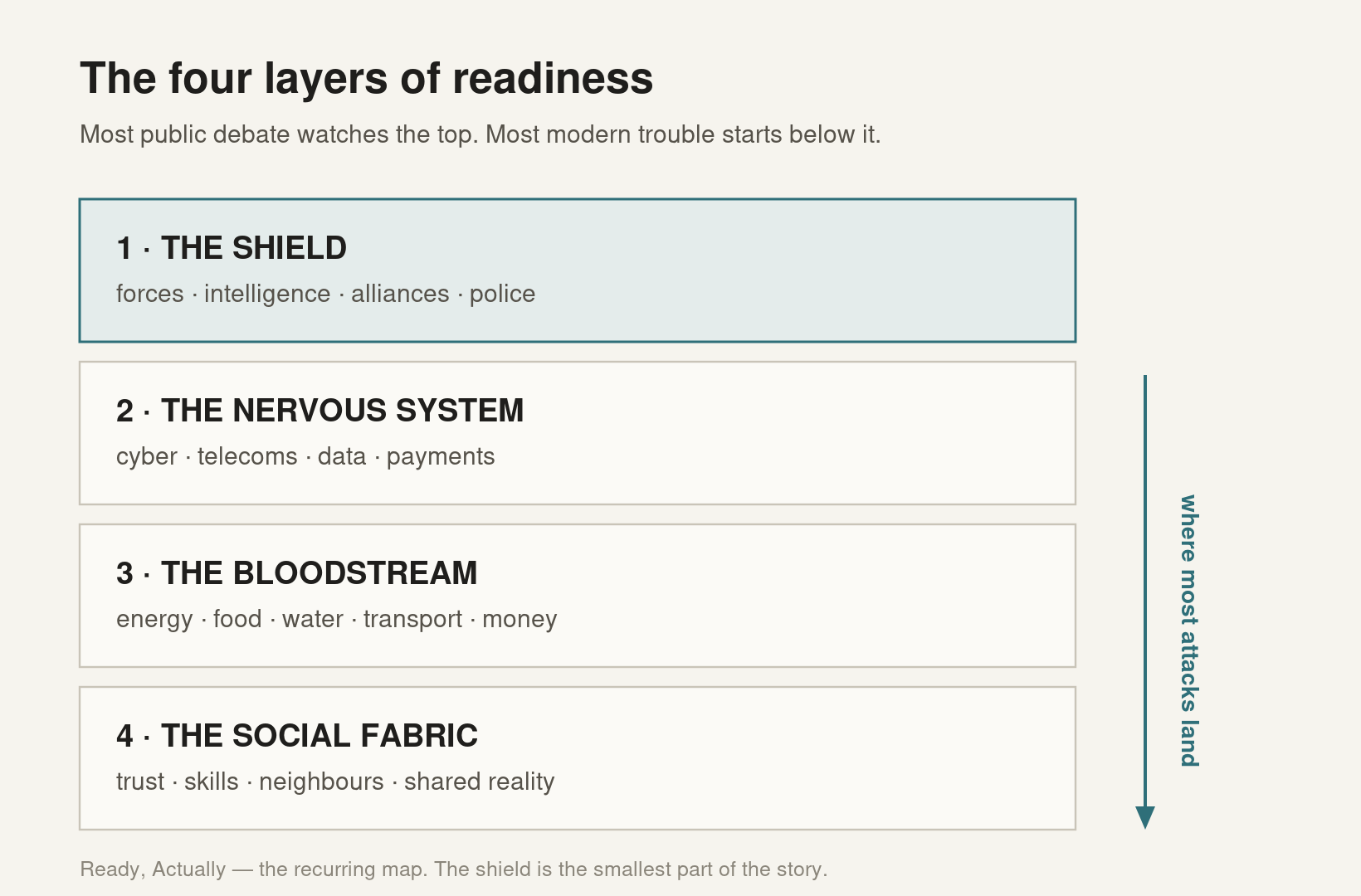
Figure 1 — The four layers of readiness.
Now here is the insight that turns this from a tidy diagram into something useful, and it’s an insight I make my living on. A hostile actor with a budget and a brain does not attack your strongest layer. That would be expensive and stupid. They attack your cheapest point of failure — the place where the smallest push produces the largest, most cascading, most demoralising mess. And cascades love to cross between layers. A cyber attack on one logistics company (nervous system) becomes empty supermarket shelves (bloodstream) becomes public panic and ugly rumours about who’s hoarding (social fabric) becomes a policing problem (shield). The comfortable assumption let Britain, like most of the West, quietly under-invest in layers two, three, and four for thirty years — precisely because those layers are invisible when they work, and politicians find it hard to win elections by spending money on disasters that haven’t happened yet.
A personal aside, because I notice these things the way only a newcomer can. When I first arrived, “security” in British public life meant the airport and the occasional grim headline — background noise you learned to tune out. Sometime after 2022 the texture changed, and it wasn’t sirens or tanks; it was subtler and stranger. A government “Prepare” message where I’d have expected an advert for a meal kit. Recruitment posters that had stopped apologising for themselves. A wartime word — resilience — turning up, unremarked, in the mouths of people selling broadband and home insurance. Nobody announced any of it. But the mood had quietly relocated, the way a room changes temperature a moment before you consciously notice someone has opened a window. The four layers had begun to show through the wallpaper of ordinary life.
It’s worth knowing that “whole-of-society” is not a novelty everyone is inventing from scratch in a panic. Some societies simply never stopped. Finland, sharing a long border with Russia and a long memory, maintained throughout the comfortable decades a model it calls total defence: broad conscription, very large trained reserves, stockpiles, and a cultural assumption that protecting the country is a shared civic task rather than a specialist profession.
To make that real, picture the image Finns themselves like to use: walk into a small-town bar and ask who there has been trained to fire an anti-tank weapon, and a startling number of perfectly ordinary people — plumbers, teachers, coders — would put a hand up. That is not a country on a war footing. It is a country that simply never let the skill atrophy. I am emphatically not about to argue that Britain should copy Finland or bring back conscription — that would be politically toxic and against everything this book stands for. The point is narrower and far more useful: that is what a society which takes readiness genuinely seriously looks like, and the distance between it and modern Britain is precisely the gap the rest of this book is about closing — voluntarily, and without the fear.
The British shift is real, and in its broad strokes it crosses party lines: more spending, a “NATO First” posture, a renewed emphasis on industrial capacity and innovation, a public “Prepare” campaign, a Resilience Action Plan, and even a proposed Defence Readiness Bill to let the state mobilise industry and reserves if a crisis escalates. Europe is moving the same way in its own accent — the EU’s 2025 White Paper for European Defence – Readiness 2030, the ReArm Europe plan, and the Niinistö report’s roughly eighty recommendations on civil and military preparedness all reach, independently, the same uncomfortable conclusion.
But — and this is genuinely to Britain’s credit, and one of the reasons I find this country worth the effort — there is visible, audible anxiety about doing all this without becoming the thing it’s defending against. “Whole-of-society” is a beautiful phrase that can curdle. Handled with care, it means healthy democratic participation. Handled badly, it could become a blank cheque for surveillance creep, emergency powers that quietly forget to expire, and the slow normalising of wartime habits in peacetime. I’ll devote a whole late chapter to those open questions, because a handbook that waved them away would be a propaganda pamphlet, not a civic one. For now, simply notice the anxiety and read it as a good sign. A country that is worried about over-reaching is a country still worth defending. The day Britain stops being nervous about this is the day to start worrying.
If you want to see the four layers being stress-tested simultaneously, look — carefully, and we will look carefully — at Ukraine.
That is not a personnel footnote; it’s a thesis with a name attached. A country at war decided the right person to run its defence was the person who had spent years fusing public digital services, startup energy, and battlefield feedback into a single fast loop. The social fabric and the nervous system, treated not as nice-to-haves but as defence infrastructure. We will give Ukraine its own chapter, and we’ll be disciplined about the difference between admiration and theft. But hold the headline: it is the clearest live evidence on Earth that readiness is a social operating system, not a warehouse of equipment.
The comfortable assumption was that the centre would always hold — that whatever happened, the professionals and the institutions would absorb it and the rest of us could carry on scrolling. The new, more honest, slightly more demanding assumption is that the centre needs distributed strength. Which is a polite, Whitehall way of saying: it needs you. Not in a uniform, necessarily. Not tomorrow. But it needs the society itself to be a participant rather than an audience. The next chapter is about the first and most visible place that participation is breaking down — and why the country’s recruitment crisis is not, at root, a recruitment crisis at all.
Pick the one of the four layers that sits closest to your actual life and skills — the one where, if you’re honest, you already have competence or relationships or habits. Just hold it in mind as a candidate. Because the rest of this book is going to keep asking the same quiet question in different costumes: given who you already are, where do you fit?
Part two is about people — why a country spending billions still can’t fill its ranks, and what “service” actually means once you strip off the Hollywood filter. The spoiler: the uniform is the narrowest door, and most of the others have no queue.
After these two chapters you’ll be able to tell a recruitment problem from a meaning problem, map the full spectrum of ways to be useful — most of them part-time, civilian, and nearer than you think — and locate the one or two routes that fit the life you actually have, without romanticising any of them.
Let me start with myself, because I am the problem this chapter is about.
I have lived in London for three years. I see the recruitment ads — on the buses, on the banners by the station, in the feed — and somewhere in my second year I caught myself asking a question I had never once asked about the country I was born in: if it came to it, would I defend this place? The answer arrived faster than I expected: yes. Not because Britain is where I happen to live, and not because anyone could compel me. Because it has become, for me, a homeland of values — and because I have lived in a great many places and never, anywhere, felt this particular thing, this dense and unshowy sense of community, the way I feel it here. Those values, and the people who built and share them, I would defend. (Ukraine, for the same reasons, too.)
In Russia there is a beloved old film, Officers, with a line everyone of a certain age can recite: “There is such a profession — defending the Motherland.” It is a fine line, and it is about real officers, with dignity, who genuinely protect their country. It is not about the men currently running mine. I never served there and never wanted to — not because I would refuse to defend a homeland, but because Putin and his people are not my homeland; they are the thing a homeland needs defending from. The Motherland and the regime are two different objects, and I will not pretend otherwise.
So — quietly, privately — I went looking. Not to enlist; I am a not-yet-naturalised foreigner and I know the limits. Just to find some pre-anything: a way to have my health, skills, and competences assessed in advance, a little orientation, so that if a bad day ever came I would not be starting from a cold stop. And I found almost nothing I could actually use. Perhaps I searched badly. But I suspect the truer answer is that for a person like me — values-aligned, willing, able, but without the passport — the door simply has not been built yet. I am, in other words, the thing this book keeps describing in the abstract: the non-consuming market of willingness, made awkwardly specific, sitting in a flat in London with no idea where to begin.
That afternoon of fruitless searching is, in miniature, the whole argument of this chapter. Britain’s recruitment difficulty is not, at root, a shortage of willing people. It is a shortage of doors. And I know this less as an analyst than as a founder — because the first time I really looked at one of those bus ads, the thought that arrived, unbidden and slightly rude, was: that’s a conversion problem, not a courage problem.
I want to dwell on that distinction, because it is the spine of this chapter and, I’d argue, one of the most useful reframes in the whole book.
When people don’t sign up for a thing, the universal first instinct — for governments, founders, charities, everyone — is to blame the people. They’re too soft. Too selfish. Too distracted. Too entitled. Too woke, too lazy, too whatever the decade’s favourite insult happens to be. It is the most natural move in the world and it is almost always wrong. I have watched a dozen founders explain that their customers “just don’t get it,” and in every single case the customers got it fine; the funnel was broken — the form was too long, the price was unclear, the value was buried, the trust was missing. When sign-ups leak, the fault is in the plumbing, not in the people who declined to get wet.
And Britain’s recruitment funnel, by the government’s own admission, leaks.
It is fashionable, in certain circles, to mock recruitment advertising — to treat every government campaign as inherently cringe, a punchline before it’s even been watched. It is also lazy, and laziness is exactly the cheap cynicism this book exists to refuse. So let me be fair to the people doing this genuinely difficult job, because the recent work is sharper than the sneer allows.
Consider the British Army’s “You Belong Here.”
Sit with how good that is, strategically. The Army identified its single largest barrier — I wouldn’t belong, this isn’t for someone like me — and instead of papering over it with stirring music, built the entire campaign around naming it out loud and answering it. That is not cringe. That is a institution listening to its own market research and having the nerve to act on it.
It is not alone. The Royal Navy runs a version of the same psychological move with “Made in the Royal Navy” and its “find your place” framing — selling not ships and hardware but becoming someone you couldn’t have become otherwise. The Metropolitan Police’s “Change Needs You” campaign sells reform-from-the-inside to precisely the people most likely to distrust the institution, and pairs the message with a genuinely radical structural change:
I am being deliberately generous to these campaigns, and not out of politeness. I’m doing it because if we’re going to find the real problem, we have to first clear away the fake one. The fake problem is “the adverts are bad.” The adverts are, on the whole, rather good. The real problem is somewhere the adverts cannot reach.
Two things, and the adverts are innocent of both.
First: a campaign is a front door, but the house behind it still has to work. An advert can make you knock. It cannot speed up an application that then goes quiet for months, reverse a medical rejection for childhood asthma, fix the pay relative to the private sector, soothe a family’s worry, or rebuild trust after a scandal that made the news. For years a great deal of the actual recruiting machinery was outsourced and widely criticised as slow and clunky — you could run the most emotionally intelligent advert in Britain and still lose the recruit in week six, not because they lost their nerve, but because the process lost their paperwork. This is exactly why the pay rise and the hundred scrapped rules matter so much more than any slogan: they are repairs to the house, not redecorations of the doorbell. The advert was never the bottleneck. The corridor behind the door was.
Second, and deeper: the adverts have to stay brand-safe, and the truest thing is rarely brand-safe. A government campaign must satisfy ministers, lawyers, journalists, and the perpetual possibility of a hostile headline. So it tends, structurally, to round off toward one of two safe shapes: service as adventure, or service as sacrifice. What it struggles to say plainly — because plainness is risky and a press office is paid to manage risk — is the stranger, truer thing:
Service is one of the few remaining institutions that will take a young person who doesn’t yet know what they’re for, hand them responsibility before they feel ready, surround them with people who genuinely depend on them, and turn them into someone demonstrably useful — at exactly the age when most of the rest of the culture offers them a feed to scroll, a personal brand to perform, and a vague, low-grade anxiety about both.
That sentence is not soft. It is the actual product. And almost no advert is allowed to say it that baldly.
There is a persistent myth that the young won’t do hard things. It is nonsense, and you already know it’s nonsense, because the very same young people will train for an ultramarathon, grind eight hundred hours into mastering a video game, learn a punishing musical instrument, move to a country whose language they don’t speak, or pour their twenties into a startup that the statistics promise will fail. They are emphatically not allergic to difficulty.
They are allergic to two specific things: being patronised, and difficulty that feels pointless or rigged. Ask a young person to suffer for something they believe is real, and they will astonish you. Ask them to suffer for something that treats them as a stereotype, or that won’t explain itself, and they will, very reasonably, decline.
So the question is never the lazy one — “why won’t kids serve these days?” The real question is sharper and more demanding: which forms of service feel credible, useful, fair, and modern enough to be worth a young person’s one irreplaceable decade? Present service only as tradition, and you lose everyone moved by impact and the future. Present it only as adventure, and you lose the ones who want moral seriousness. Present it only as a stable career, and you lose the ones who want a cause worth a scar. Present it only as duty, and you lose the ones who first need to know whether the institution will treat them like an adult and a person.
Meaning, in other words, is not a soft garnish you sprinkle on top of the “real” offer of pay and pension. Meaning is the infrastructure of commitment. It is the load-bearing structure. Everything else — the salary, the kit, the adventure — hangs off it.
Here is a move the state has only half-learned, and it’s worth more than it looks.
The best way to recruit a technical person is not to show them an inspiring photograph of a technical person looking fulfilled. It is to hand them a problem and let the work itself do the seducing. Show a real puzzle — a signals problem, a logistics optimisation, a captured piece of malware to reverse-engineer — and the right kind of brain leans in before it has even registered that there’s a uniform attached to the offer. Hackers do not fall in love with lanyards and recruitment fairs. They fall in love with the problem nobody would previously let them touch.
Britain has, quietly, started doing exactly this.
This is the part where I have skin in the game, so I’m going to be slow and exact, because vagueness here would be a small betrayal of the whole project.
A common, defeated assumption among migrants is that British service is simply closed to them — that the national-security conversation is, by definition, happening in a room they’re not allowed into. It isn’t. But the truth is specific, and — crucially — it moves, which is exactly why you should never take a book’s word for it over an official page checked on the day.
I’ll be honest about why I labour this. The “another foreigner muscling in” anxiety is one I carry myself, and the answer to it is not to pretend the rules don’t exist or to over-claim a welcome that has to be earned. The answer is precision and humility: here is what’s genuinely open, here is what genuinely isn’t yet, here is how you verify, and here is the spirit in which a newcomer contributes — quietly, lawfully, and without demanding a uniform the country isn’t ready to hand them. That posture, it turns out, is also just good citizenship for anyone, passport or not.
Make a four-column map — Uniform / Public service / Technical-civilian / Local-community — and under each column write one route you would genuinely consider, not merely admire from a comfortable distance. Then, beside each, write the single fact you’d have to verify before you could actually apply. That’s it. You will have just done more concrete, honest thinking about a life of service than the overwhelming majority of people who hold loud opinions about recruitment on the internet.
Next, we take the word that’s been hiding behind all these posters — service itself — and strip the Hollywood filter off it, because the honest version is both less glamorous and far more persuasive than the one with the swelling strings.
The word “service” is trapped between two bad posters, and almost nobody is allowed to take it down off the wall and look at the actual thing behind it.
The first poster is sentimental. Noble silhouettes against a dawn sky. Swelling strings. A clean moral horizon, a flag catching the light, a grandmother’s proud tear. It is the poster of remembrance and recruitment alike, and it isn’t false exactly — but it is varnished to a high shine that real human beings can smell from across the room.
The second poster is cynical, and it has been going up steadily for thirty years. Bureaucracy. Scandal. Underfunding. Kit that doesn’t work. Veterans failed by the system that used them. The quiet suspicion, absorbed almost by osmosis, that only a mug signs up — that service is what happens to people who didn’t have better options or weren’t clever enough to dodge it.
Reality lives in the unphotogenic space between the two posters, and that space is where this chapter wants to take you, because it’s the only place an adult decision can actually be made.
Service can be meaningful and badly managed. It can build a person and exhaust them in the same year. It can be genuinely noble without being remotely glamorous — most of it is admin, waiting, and maintenance, punctuated by moments that matter more than anything else the person will ever do. It can ask far too much and give back something that has no price. It can disappoint an idealist and rescue a cynic from their own uselessness in the very same week. The honest version is more persuasive than the polished one, for a simple reason: people can smell a recruitment poster from a mile away, but they cannot smell the truth. The truth just reads, quietly, as real — and real is the rarest and most attractive quality in a culture drowning in performance.
The single most expensive false belief in this whole area is that “serving” means “joining the regular army full-time.” It is one option at the far end of a wide spectrum, and the overwhelming majority of that spectrum requires no barracks, no haircut, and no permanent commitment:
🔘 the regular forces, and the reserves (who serve part-time while keeping their civilian careers — the model most compatible with an ordinary life);
🔘 cadet adult-volunteer roles, mentoring the next generation;
🔘 the special constabulary — volunteer police officers with full warranted powers, giving evenings and weekends;
🔘 community first responders, ambulance volunteers, and the lifeboats (the RNLI is, let us never forget, a charity crewed largely by volunteers who go out when everyone else is coming in);
🔘 fire-service and flood-response routes where they exist;
🔘 the civil service and the public-sector digital and cyber professions, where a huge amount of national resilience is quietly done by people who never think of themselves as “serving”;
🔘 local-authority resilience and emergency-planning work — the unglamorous spine of how a town survives a bad week;
🔘 defence-adjacent engineering and manufacturing;
🔘 dual-use startups solving a civilian and a security problem with the same product;
🔘 charities working with veterans, migrants, homelessness, and rehabilitation;
🔘 and the mutual-aid networks that look like nothing on an ordinary Tuesday and become genuinely load-bearing the day the river comes over the wall.
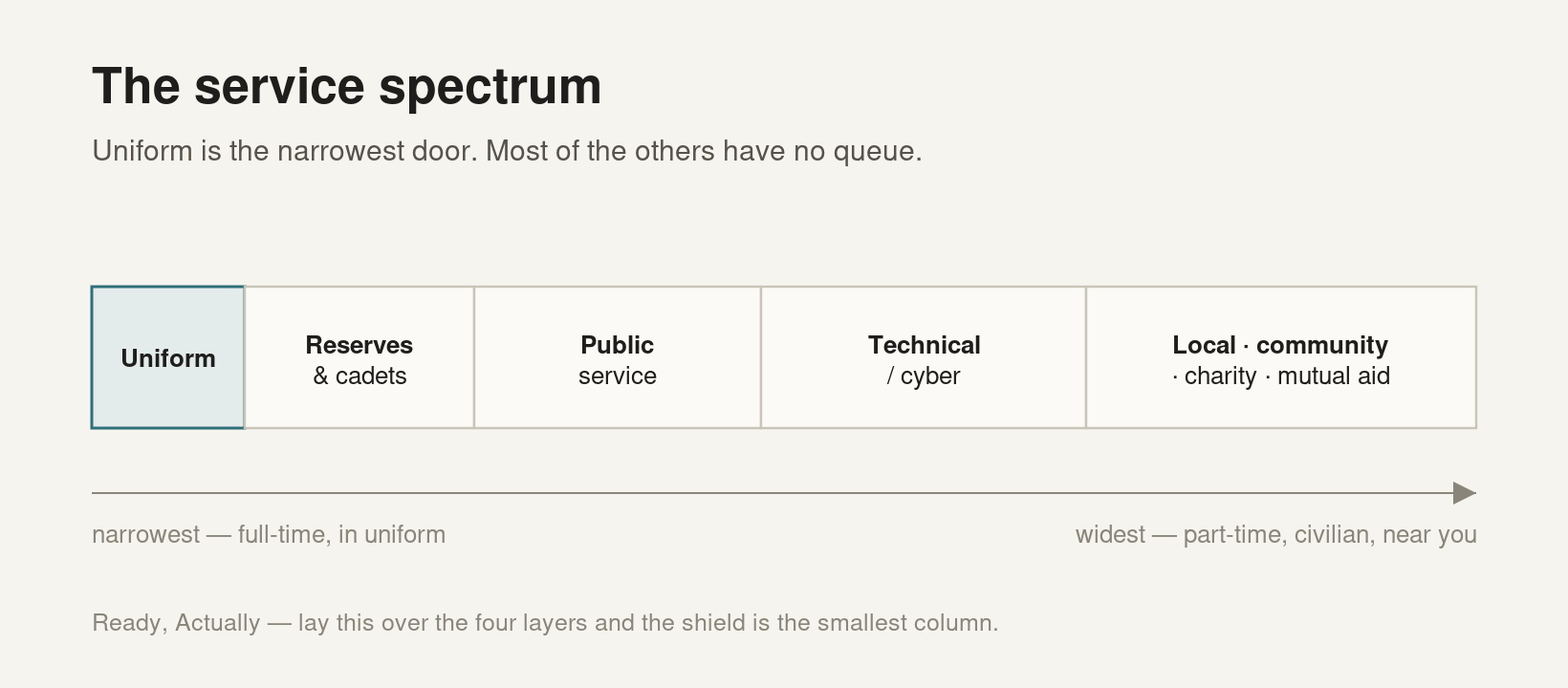
Figure 2 — The service spectrum: uniform is the narrowest door.
You do not need to be pushed toward any one of these. Pushing is what the bad posters do. You need a truthful map and the dignity of choosing your own square on it.
I work in technology, so I know the flinch from the inside, intimately. A certain kind of thoughtful engineer hears “defence” and recoils — and some of that recoil is healthy and should be protected, not lectured away. Dual-use technology genuinely can be misused. Procurement genuinely is opaque. Hype genuinely outruns ethics, constantly; I have watched founders begin a pitch with “we save lives” and end the same slide deck sounding like a first-person shooter with a valuation.
But — and I say this as gently as I can — refusing to think about the problem does not make the problem more ethical. It just guarantees that the field is shaped entirely by people who flinch less, and scruple less, than you would have. The technology is being built either way. The drones, the autonomy, the battlefield AI, the surveillance tools: they exist, they are improving, and they are being sold. The only variable you actually control is whether anyone in the room building them shares your discomfort. A thoughtful person inside the process, asking the awkward question about oversight and misuse, is worth incalculably more than a principled person standing outside it, morally intact and completely without influence. The boundary work — cybersecurity, secure comms, sensing, medical logistics, search-and-rescue, energy resilience — is exactly where conscience is most needed and most absent.
I told you in the very first pages that I’m a pacifist, and I want to spend a moment proving that this is not in tension with a single line of this book — because if it were, the book would be a fraud, and I’d rather not write a fraud.
Opposition to war is not the same as indifference to aggression. These are routinely confused, usually on purpose, by people who want pacifism to mean passivity. It doesn’t. A pacifist can believe in deterrence — can be a porcupine — precisely because they want fewer human beings to die, and deterrence is the cheapest way known to history to achieve that. A humanist can care, with their whole chest, about whether hospitals and ports and payment systems and democratic institutions survive contact with pressure, because those are the systems that keep actual human beings alive, fed, treated, and free. The opposite of militarism is not helplessness or moral purity. The opposite of militarism is a society so quietly competent that violence against it stops looking like a good bet — which means fewer funerals, on all sides, including the aggressor’s conscripts.
For readers carrying genuine moral discomfort — keep it. It is not a bug; it is one of the most valuable instruments you own. But point it at the right questions, which are questions and not slogans:
Does my refusal to engage actually reduce harm — or does it just outsource the risk to someone with fewer options and less conscience than me?
Which specific forms of contribution genuinely fit my values, and which don’t?
Where, exactly, is the line I will not cross — and have I decided it now, while the deciding is calm and cheap, rather than later, when fear has narrowed the room and every shortcut looks reasonable?
That last question is, quietly, one of the most important in the book. Decide your lines in peacetime. Pressure is a terrible time to discover you never had any.
Migrants often understand fragility in their bones, because a great many of us have personally watched the supposedly permanent thing — a currency, a government, a sense of safety, a future — simply collapse. In the context of national resilience, that is not a weakness or a suspicion to be managed. It is a rare and useful form of literacy that most lifelong citizens, through sheer good fortune, have never had to acquire. We bring languages, technical skills, logistics experience under real stress, medical training, entrepreneurial appetite, and — I’ll speak for myself — an almost embarrassing earnestness about a free society, of the particular intensity you only find in people who have seen the alternative up close and did not enjoy it.
But the honest framing is belonging, not access, and the order of those words matters. Sensitive roles require trust, time, and vetting, and that is entirely reasonable; I would want my adopted country to be careful, and I’d be suspicious of one that wasn’t. Contribution can begin everywhere else, and there is an enormous everywhere else: local volunteering, public-service-adjacent work, cyber upskilling, community resilience, founding useful things, charity, the patient ordinary business of lawful civic life. You contribute your way in. You do not demand your way through. (And yes — I’m aware of the irony that a Russian is the one writing that sentence. I’ve made my peace with it. The sentence is true regardless of who’s inconvenienced by the messenger, and being the inconvenient messenger is, increasingly, a role I’m comfortable in.)
Pick one route from the spectrum above — just one — and write four honest lines about it: what genuinely attracts me, what genuinely worries me, what I’d need to verify before acting, and what would make this route morally acceptable, or unacceptable, to me. The goal is not instant enlistment. The goal is adult clarity. And here is the quiet thing worth noticing: a society made of people who have thought this clearly — who know their own lines and their own fit — is already, in the only sense that finally matters, far more ready than one made of people waiting to be told what to feel.
Next, we stop circling the official documents and actually open them — because the state has written down, in black and white, what it thinks the future looks like, and it is both more honest and more genuinely interesting than the headlines ever allowed.
Part three hands you the source code. We open the strategy documents the headlines only gesture at, sort what’s genuinely settled from what’s still a real fight, and then look — carefully, and without looting — at Ukraine, the one place where all of this is being tested for real.
After these chapters you’ll be able to read an official document like a contract rather than a sermon, hold an informed view on the debates that aren’t settled, and tell the difference between a lesson Britain can borrow and a cost that was never ours to take.
I’m going to ask you to do something almost nobody does voluntarily: take the government’s strategy documents seriously. Not reverently — seriously. The difference between those two words is the whole chapter.
To read a document reverently is to assume it’s true because it’s official, salute the cover, and absorb the vibe. To read it seriously is to read it like a contract you’re about to sign with your own money: looking for what it commits to, what it merely aspires to, and what it’s carefully not saying in the paragraphs everyone skims. Reverence is useless. Seriousness is a civic superpower — and almost nobody uses it, because the documents are long, the language is grey, and the press would rather tell you who’s winning the argument than what the argument is.
Here’s the professional habit I can’t switch off. When a founder hands me a strategy deck, I skip the vision slides — anyone can write vision slides — and go straight to the only question that separates a real plan from a beautiful PDF: where is the committed capital, and what’s on the slide they’re hoping I won’t ask about? Read Britain’s 2025 security documents that way and they stop being wallpaper and turn genuinely gripping — because they are unusually honest about the danger and unusually slippery about the bill.
Four documents are worth knowing by name. You’ll never read any of them cover to cover, and you don’t need to — you need the spine of each.
And then the single fact that makes all of it real — the one I’d put on the cover if it were my book to deface:
“When funding allows” is, I’d argue, the four most important words in all 62 recommendations — and we’ll come back and stand on them.
You asked me to keep an eye on the near neighbours, and something striking is happening: a whole continent of democracies is arriving, separately, at the same uncomfortable sentence.
The takeaway isn’t the institutional plumbing. It’s the convergence. When the UK, the EU, the Nordics, and the Baltics — wildly different in history and political culture — independently reach the same conclusion, that conclusion deserves more of your attention than any single politician selling it. The shared sentence is roughly: prosperity requires protection, and protection can no longer be quietly outsourced to yesterday’s assumptions. You don’t have to like it. But a continent didn’t reach it by accident.
Now the structure I promised in the first chapter — the thing the press almost never does, because “here’s what’s settled and here’s what’s still a real fight” doesn’t drive engagement the way a winner and a loser do.
Where there is broad consensus (the settled weather):
the threat picture has structurally changed, and complacency is no longer free;
NATO and Euro-Atlantic security come first;
industrial capacity and the speed of innovation are now part of deterrence, not a side-quest;
and “whole-of-society” is real — the public is inside the security system, whether it volunteered or not.
Where it is genuinely contested (here you owe yourself an opinion):
The money. The big one. Critics across the spectrum — including sympathetic, expert ones — argue the SDR reads “more as a statement of strategic intent than an executable programme,” with an “implementation gap” between ambition and committed funding. The targets are a moving cloud: 2.5%, then perhaps 3%, with NATO’s Secretary-General pressing for 3.5% and Washington pushing 5%. Inference [Moderately evidenced]: a strategy without funding certainty is a pitch deck without a term sheet. Read the gap between the vision and the committed capital as the place where the real decisions are still being quietly deferred — usually to a future minister.
Prioritisation. The documents name Russia, China, Iran, and North Korea but decline to rank them, and gesture at the Indo-Pacific and Middle East while committing little to either. Naming every threat is a sophisticated way of prioritising none — and it tends to spread the money into a film too thin to stop anything.
Conscription. Fact [Strongly evidenced]: the previous government floated mandatory national service for 18-year-olds in 2024; the current government says it has no plans for it; polling shows a large majority opposing a compulsory draft while supporting voluntary schemes — even as Lithuania, Sweden, Latvia, and Croatia have reintroduced forms of military service. This book takes a side: voluntary, modular, paid, dignified routes, not coercion. A drafted society is not a willing one, and willingness is the quill that actually deters. Force it and you get bodies, resentment, and a backlash that sets the project back a decade.
Militarisation itself. It would be dishonest to skip the strongest dissent: serious critics argue the whole turn risks “perpetual militarisation” and the normalising of wartime thinking in peacetime. I don’t agree with where that argument lands — I think it underrates the threat — but every reader should meet it, weigh it, and decide. Platforming the argument you disagree with is one of the things a free society is for.
What is still genuinely open — the brainstorm the state hasn’t finished, where civic thinking (including yours) has room:
Where does the money truly come from, against hospitals, schools, courts, and debt?
How does a liberal democracy define, limit, audit, and retire emergency powers, so “whole-of-society” never curdles into permanent surveillance?
Who pays to harden privately-owned critical infrastructure whose failure becomes a public catastrophe?
And the deepest: how do you earn public consent for hard trade-offs before a crisis narrows the room to a single panicked option?
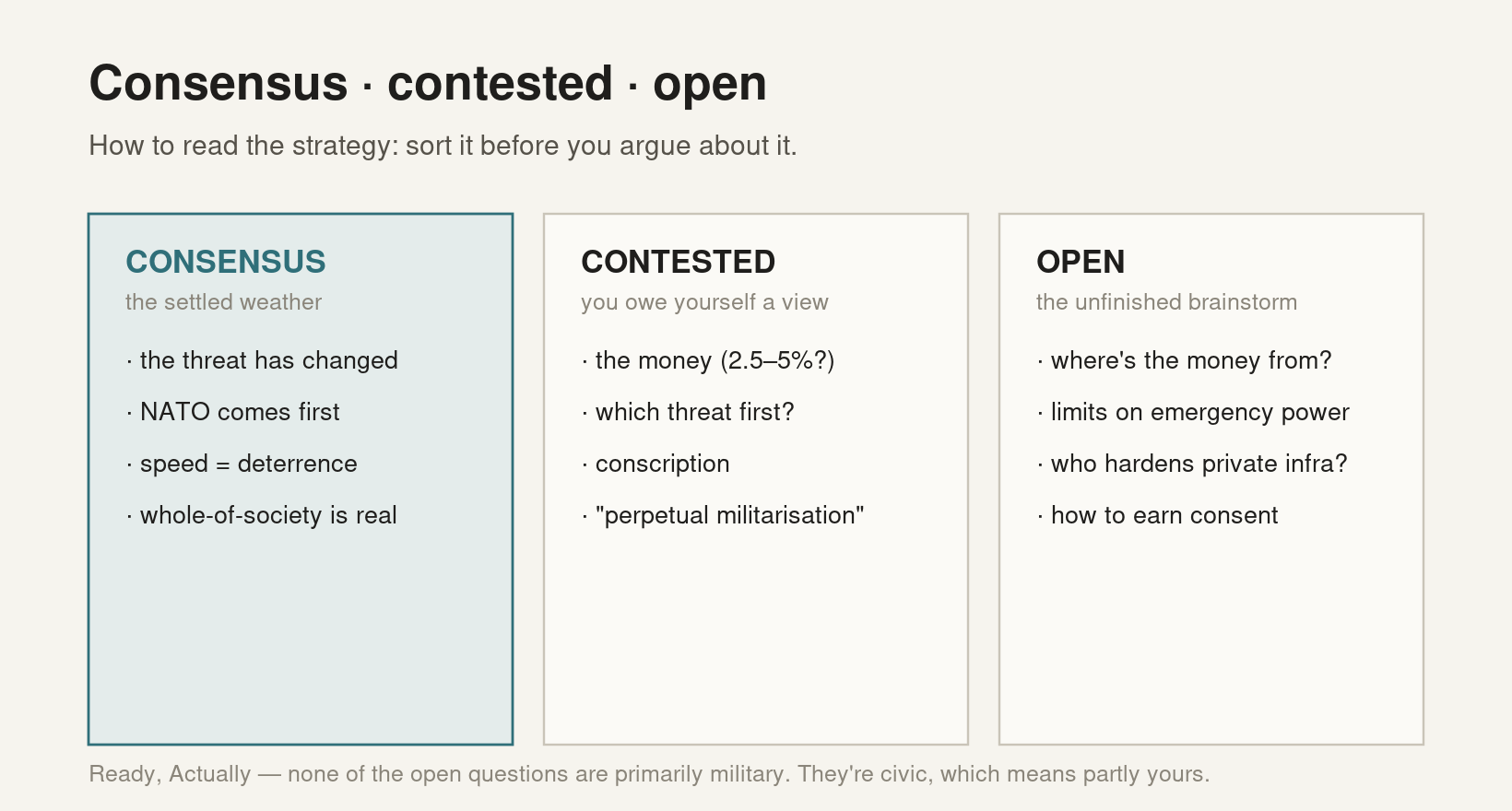
Figure 3 — Consensus, contested, open: how to read the strategy.
We’ll give these a chapter of their own near the end. But notice now: none are primarily military questions. They’re about money, law, ownership, and trust — which is to say civic questions, which is to say partly yours.
Pick the “contested” item that bothers you most — money, priorities, conscription, militarisation — and write your position in three lines: what I believe, what evidence would change my mind, what safeguard I’d insist on regardless. Then do the civic thing: find someone who’d answer differently, and have the conversation without trying to win it. A society that can still argue like that is the single hardest target an adversary can face — it cannot be panicked into turning on itself.
Next: the country where all four layers are being tested at once — and what it would be obscene to take from it, and foolish not to learn.
I have to be careful in this chapter, and I want to tell you why before I write a word of analysis, because the carefulness is the analysis.
I am not neutral about Ukraine. I won’t pretend to be, and you’d see through it if I tried. And a book that turned a country’s ongoing catastrophe into a tidy listicle of “seven lessons for Britain” would be obscene — it would be committing, in prose, the precise sin this whole book stands against: treating other human beings as raw material for someone else’s purposes. So the discipline I’m going to hold, and ask you to hold with me, is a simple three-way separation: admiration, transferable lesson, and non-transferable context are three different things, and respect means never letting them blur. Ukraine is not a metaphor. It is not a case study that volunteered. It is a country under fire that happens, at terrible cost, to be running the most important live experiment in national resilience anywhere on Earth — and the least we owe it is to learn without looting.
Strip everything down to the single structural insight, and Ukraine demonstrates this: resilience is a social operating system, not a stockpile.
Read that twice, because it inverts the instinct most people start with. When we imagine a country “ready” for war, we picture warehouses — of shells, of fuel, of tanks. Those matter. But what Ukraine has shown the world since 2022 is that the decisive variable is not what’s in the warehouse; it’s the operating system running the society: the ability of a government to keep functioning when its buildings are rubble; of citizens to reach state services through a phone when the office is gone; of volunteers to self-organise faster than any ministry could order them to; of technical communities to take a frontline problem on Monday and ship a solution by Friday; of a whole population to learn, adapt, and not panic under conditions specifically engineered to make it panic. Notice where almost none of that lives: not in the shield. It lives in the nervous system and the social fabric — the two layers comfortable countries chronically under-fund.
Here is where my professional brain lights up like a fruit machine, and where I think Britain genuinely has the most to gain — and the most to feel slightly embarrassed about.
Now read that again not as a war-watcher but as a systems person, because that’s where the transferable gold is. Ukraine did not merely build a lot of drones. Under existential pressure, it accidentally built the lean-startup version of a defence ministry: a two-sided marketplace connecting frontline demand to certified supply, a fast grant engine to seed the supply, and a brutal, beautiful feedback loop that pays for results rather than promises and routes battlefield data back into design in weeks rather than years. The thing the entire Western defence-procurement world has failed to solve for decades — the “valley of death” between a working prototype and an actual order — Ukraine compressed, under fire, into something close to continuous deployment.
That is the lesson worth its weight in this chapter, and notice it has nothing to do with copying a particular weapon. It’s a lesson about speed, feedback, and the structure of demand — which are organisational and cultural, not technological. A comfortable country could, in principle, learn it on purpose, in peacetime, without paying Ukraine’s price. Whether it has the institutional humility to do so is a different question.
I keep returning to this appointment because it is a thesis wearing a job title. A country at war looked at the question “who should run defence?” and answered: the person who spent years fusing public digital services, startup energy, and battlefield feedback into one fast loop. Diia matters here not as an app to be admired but as a demonstration of a principle: a trusted civic interface — the thing citizens actually touch in order to deal with their own state — can itself become a resilience asset when the crisis comes. When the state can reach its citizens, and citizens can reach the state, through a channel they already trust, the whole society can coordinate at a speed that an adversary finds genuinely difficult to disrupt.
And here is the non-transferable context, stated as plainly as I can so that no one mistakes my enthusiasm for a recommendation. Britain should not copy Diia. Centralised digital identity and state civic platforms are politically loaded in the UK for genuinely good reasons — a deep and healthy suspicion of state databases, a history of surveillance debates, real risks of exclusion for people who can’t or won’t go digital, and hard-won institutional distrust. The honest question is not the lazy one, “where is Britain’s Diia?” It is the much harder one: what would a democratic, privacy-respecting, genuinely-useful-in-a-crisis civic interface look like in a country that is rightly suspicious of building one? That is not an app specification. It is a decade-long argument the country hasn’t finished having, and shouldn’t rush.
Let me put the two lists side by side, because the discipline of this chapter is precisely in keeping them separate.
The temptation, for a comfortable and well-meaning country, is to take the inspiration and quietly skip the cost — to be moved by the drone footage and the digital-ministry story without sitting with the fact that all of it was paid for in lives by people who never once got to treat any of this as theory. The discipline is to take the structural lesson — adaptive speed, real feedback, trusted interfaces, distributed strength — while remembering, every single time, where the bill was sent and who is still paying it.
I’ll add one personal note, and then I’ll stop, because this is the chapter where I most have to watch myself. I came to this subject caring about Ukraine, and that care is a bias I’ve tried to discipline rather than hide. But the discipline cuts the right way: because I care, I refuse to flatten what’s happening there into a neat argument for a British book. The respect and the rigour turn out to be the same act. If this chapter has done its job, you finish it understanding the lesson — and feeling the weight of where it came from.
The next time you read about Ukraine — a drone strike, a digital-ministry headline, a volunteer story — run the three-way split in your own head, deliberately: what here is admiration, what is a genuinely transferable lesson, and what is non-transferable context I have no right to flatten into a slogan? That small mental discipline is, in itself, an act of respect. It is also — not coincidentally — exactly the kind of careful, un-panicked thinking that makes a society harder to manipulate, which is the whole point of everything in this book.
Next: the chapter where the civilian and the soldier turn out to be building the same arsenal — and where “defence technology” stops being a phrase that makes thoughtful people flinch and starts being, for a great many of you, simply a Tuesday.
Part four is about what gets built, and by whom. First the arsenal that turns out to be half-civilian — dual-use technology, and why “defence tech” should make you curious rather than queasy. Then the readiness dividend: how investing in the people a brittle society wastes makes the country both kinder and harder to break.
After these chapters you’ll be able to ask the right question about any dual-use tool — who controls it, with what brakes? — and to see resilience and social decency, for once, as the same line item rather than rivals.
Ukraine, in the last chapter, did not hold on with soldiers alone. It held on with software teams, drone workshops, volunteer networks, and a citizenry that quietly turned itself into an arsenal. Which raises the question this chapter exists to answer: what is the modern arsenal — and who actually builds it?
The word “arsenal” makes most people picture steel: warships, jets, missiles, a 1940s factory floor in grainy newsreel. That arsenal still matters — steel hasn’t retired, and anyone who tells you drones have made tanks obsolete is selling a thesis, not describing a battlefield. But the modern arsenal also runs on software, secure cloud, logistics firms, cyber ranges, AI models, additive manufacturing, commercial satellites, simulation — and the venture capital needed to drag a prototype across the chasm to a production line. A great deal of it is being built, right now, by people who’d be startled to hear themselves called part of national defence.
One warning up front, because I do this for a living. This is a bridge chapter, not the heart of the book. There’s a whole separate book to be written about defence innovation, and I’m deliberately not smuggling it in here — that would break the promise this book made on page one: to stay a civilian’s handbook, not a founder’s manual. What matters for you is narrower: “defence technology” is no longer a sealed world of insiders with clearances — and, I say this with affection for my own industry, the scariest thing in the sector is usually the PowerPoint, not the technology.
This isn’t a forecast. The capital has already moved, and you can see where it landed.
You don’t need an opinion on any one of those firms — a thoughtful person might hold some sharp ones. The point is structural and prior to the ethics: Britain has decided to become a magnet for this, and the decision is working. Which means the question a thoughtful reader once filed under “not my world” — should people like me touch this? — has quietly become a live career and conscience choice, whether you sought it or not.
The phrase frightens people because it sounds like a euphemism for dressing weapons in civilian clothes. It isn’t. Dual-use simply means a technology has genuine applications on both sides of the civilian-defence line:
a drone that inspects a wind turbine on Monday and watches a border on Tuesday;
a cybersecurity tool that defends a high-street bank and a military network with the same code;
an AI model that routes ambulances in peacetime and, fed different data, helps detect threats;
satellite imagery serving crop forecasts, flood response, and battlefield awareness from one orbit;
robotics built for warehouses, deployed for search-and-rescue, adaptable to contested environments.
Which is exactly why a thoughtful person in the room matters more than a principled person standing righteously outside it. The technology gets built regardless of your participation. The only thing your absence guarantees is that the room contains one fewer conscience.
If “the arsenal is partly civilian” sounds like a novelty, it isn’t — Britain built one of the purest versions of it. In 1937 a project called Mass Observation recruited thousands of ordinary people to keep diaries and answer regular “directives,” creating a citizen sensor-network that mapped the nation’s mood and resilience straight through the war years. No uniforms, no weapons — just civilians paying structured attention and reporting what they saw.
The modern, sharper-edged version is running in Ukraine right now. Through a chatbot called eVorog — built, fittingly, by Fedorov’s digital ministry — ordinary Ukrainians have sent well over 600,000 reports of enemy movements and equipment, much of it routed straight to the people who can act on it. Fact [Moderately evidenced]: eVorog has handled on the order of 600,000+ citizen reports across the full-scale war. Civilian sensing isn’t a frightening import from a war zone. It’s a British tradition from the 1940s waiting for a technological upgrade — and proof that the line between “civilian” and “arsenal” was always thinner than it looked.
Here’s the part the cheerful press releases skip — and the part that keeps this chapter honest rather than promotional.
A startup can build a working prototype fast. A government can take years to buy it. The chasm between those facts has a grim industry nickname — the valley of death — and it’s where most good defence-relevant ideas quietly die: security-clearance delays, requirements that won’t sit still, procurement cycles measured in years against venture runways measured in months, export-control mazes, no access to test environments, integration with decades-old legacy systems, and the brutal uncertainty of whether the demand will ever become a signed contract before the money runs out.
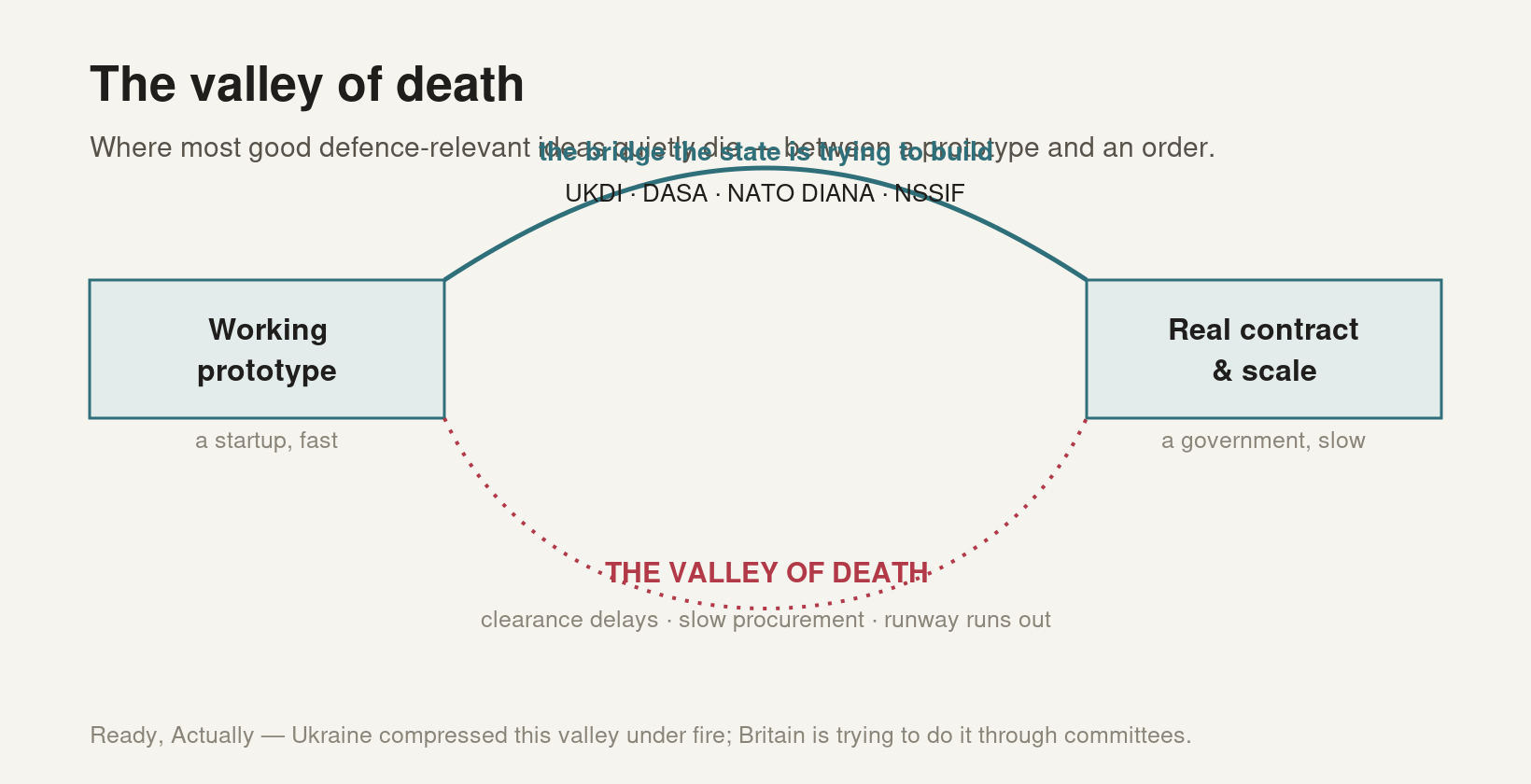
Figure 4 — The valley of death, and the bridge the state is trying to build.
And lest I sound like a brochure for the new regime:
I include that last line on purpose: a book that quoted only the £400 million headline would be doing PR, not telling you the truth. And the truth is more useful — the valley of death is structural. It isn’t closed by announcing a new body with a good acronym. A state that says it wants rapid adaptation but can’t actually buy, test, integrate, and scale at speed has a strategy that exists only on paper. Ukraine compressed that valley under fire, at horrific cost; Britain is trying to do it on purpose, in peacetime, through committees — which is, in its way, a harder trick than it sounds, and worth watching with sympathy and scepticism.
And if it’s any comfort, the enemy in this valley is an old British adversary. Through the late 1930s, the man who would shortly run the war spent his “wilderness years” fighting less against Germany than against his own side’s machinery — the risk-averse officials, the committees that mistook caution for wisdom, the Treasury minds for whom the safest decision was always to defer. Churchill’s pre-war struggle was, in large part, against institutional inertia: the long British habit of preparing slowly and apologetically until the crisis does the deciding for you. The valley of death is that habit in modern dress. Beating your own bureaucracy before an adversary forces you to isn’t a new test of national readiness — it’s close to the oldest one Britain has.
If you’re technical, or you invest, the genuinely useful map — live competitions, open calls, deadlines — moves far too fast for print and will live on the companion site rather than rot in a paper book. But the named doors are worth knowing, and several are open wider than people assume:
UK Defence Innovation (UKDI), and DASA within it — the front door for UK defence innovation.
NATO DIANA — the alliance-wide accelerator, grants of roughly €100,000 with follow-on up to ~€300,000. Being NATO-wide, it is by design not a UK-citizens-only proposition.
NSSIF — the National Security Strategic Investment Fund, the government-backed venture investor via the British Business Bank.
the Defence Office for Small Business Growth, Defence Innovation Loans, and various Innovate UK routes.
Most readers here will never found a dual-use startup, and that’s fine. So what’s the takeaway for the nurse, the teacher, the accountant, the retired engineer? Just this: defence innovation is no longer a niche performed by insiders on your behalf in a building you’ll never enter. It’s part of national resilience, it’s partly funded by your taxes, and it’s shaped — for better and worse — by whether ordinary, thoughtful citizens understand it well enough to ask good questions, support sensible governance, and resist both the breathless hype and the lazy reflex that anything with “defence” in the name must be sinister. Understanding the arsenal is itself a civic contribution. You don’t have to build a drone to be a useful citizen of a country that does.
If you work in or near technology, answer one honest question and write it down: what part of my skill set would still matter if the internet, the supply chain, public trust, or the power grid were under real pressure? That sentence is your first resilience map — and quite possibly the most valuable line in your CV that your CV doesn’t mention.
Next, the chapter I find at once the most personally important and the most dangerous to write — about the people a brittle society wastes, and the dividend a ready one earns by refusing to.
Let me state the guardrail before the argument, because the argument is dangerous without it.
There is an ugly version of this chapter, and I reject it completely. It says: vulnerable people — prisoners, the homeless, the unemployed, migrants — are useful because a country bracing for trouble needs bodies, and here is how to harvest them. That version is monstrous, and the precise inversion of everything this book believes. People are not raw material for mobilisation. A society that looks at its struggling members and sees recruits, or inputs to be extracted, has already surrendered the thing it claims to defend. If you take one sentence from this chapter, take that one.
Here is the version I’ll defend — and the distance between it and the ugly one is the whole moral architecture of the book:
Readiness should not only harden the state. It should widen belonging. A society that invests in skills, structure, trust, rehabilitation, stable housing, and lawful routes into contribution becomes both more just and harder to break.
That second clause — and harder to break — is the readiness dividend: the kindness and the resilience are the same investment seen from two angles. And the unsentimental half, so the humane version doesn’t sound naive: a country that writes off whole categories of its own people carries enormous idle capacity on its national balance sheet. Wasting people isn’t only a moral failure; it’s a security weakness — a society running below its potential, brittle exactly where it could be strong.
Resilience runs on deeply unglamorous skills: logistics, repair, fabrication, basic cyber hygiene, care work, emergency response, driving, construction, data handling, translation, food distribution, the quiet competence of local coordination. Two things about that list: none of it requires a uniform, and almost all of it can be taught — through colleges, apprenticeships, charities, local authorities, employers. Every one of those skills is at once a livelihood for a person and a quill in the national porcupine. That overlap — where helping a struggling individual is the same act as strengthening the society — is the entire opportunity of this chapter. It’s the rare policy space where compassion and hard-nosed resilience aren’t in tension but are literally the same line item.
If you suspect this is warm-hearted hand-waving, look at what happens when you give someone the system has written off a genuinely hard, genuinely valuable skill.
Those numbers should stop you, and not for sentimental reasons. Reoffending is one of the most expensive, self-perpetuating failures a society runs: every reoffence is a fresh victim, a fresh trial, a fresh prison place, and a person cycling deeper into a hole. A programme that turns even a fraction of that waste into employed, taxpaying developers is doing social good and resilience-building in one stroke. That is the readiness dividend made concrete — not a feeling, a result.
The guardrails are not optional, because this is exactly where good intentions slide toward the ugly version: no access to sensitive systems without lawful vetting; no coercive “work off your sentence” framing; no glamorising of criminal skill; no operational-security shortcuts; and no fantasy that everyone deserves, and therefore gets, a second chance in security-adjacent work. (This is why, earlier in the book’s development, I killed an idea I’d toyed with — a migrant “tech legion.” The substance was sound: lawful, civilian, technical routes. But the label carried a paramilitary swagger that betrayed the careful point underneath. Kill the brand; keep the help.) The claim is narrow on purpose: properly governed, non-sensitive resilience sectors can absorb people the system currently discards, to everyone’s benefit.
Let me be careful in the other direction now — this is where the ugly version lurks closest.
Homelessness is not a recruitment pool. It is a social failure and a human emergency, full stop; any sentence that treats it primarily as an opportunity has already gone wrong. But readiness thinking — funding stability before a crisis rather than mopping up after — underwrites exactly the things that help a person anyway: housing-first pathways, ID and documentation support, health and addiction services, employability training, and, where genuinely appropriate and genuinely chosen, paid work in local resilience, repair, and logistics. The test is simple, and you should hold the state to it: are we funding stability because it serves the person? If yes, the resilience benefit is a welcome side effect. The moment that logic inverts — stability funded in order to extract usefulness — it has crossed into the ugly version, and the dividend curdles into the thing this book exists to oppose.
Two groups make the dividend vivid, at opposite ends of the same bridge.
That’s the dividend flowing out of service into the civilian dual-use economy — turning the discipline and clearance-readiness of former service personnel into exactly the cyber and tech capacity the national strategy keeps saying it lacks. The same architecture — a structured bridge from an under-used group into needed skills — could lawfully and humanely serve migrants too. Migrants often arrive having already survived the collapse of something they assumed was permanent: a form of resilience literacy most settled citizens never had to acquire. Framed as belonging rather than access — starting where the door is open, accepting that sensitive roles take time and vetting — that capacity is a gift a smart country accepts rather than a problem it manages. A ready society builds those bridges deliberately; a brittle one lets people fall into the gap and then wonders why it feels short-staffed.
Step back and the dividend resolves to one sentence: a society that wastes people is brittle; a society that finds lawful, dignified ways for more people to be needed is both kinder and harder to break. That isn’t a left-wing idea or a right-wing one — it’s a structural one. The compassion case and the security case point, for once, at the same policies. When that happens, reach for them first and fastest; the alignment is rare and won’t last.
Two questions, in this order — the order is the ethics. First: who in my community is treated mostly as a problem, but could be part of resilience if the system offered dignity, structure, and a real, valued skill? Then the harder one, which keeps the ugly version out: what safeguard would make that contribution genuinely chosen and genuinely fair — and would I still support it if it were my own name on the list?
Next, the chapter where I stop pretending I have the answers — the open questions, the civil-liberty trade-offs, the things that should keep a thoughtful person honestly awake. A handbook that faked certainty about those would have failed its own first test.
The final part stops pretending the answers are settled, then asks you to do something anyway. First the open questions — civil liberties, money, consent — that a free society has to keep arguing about out loud. Then the field guide: six plain verbs, and the one or two that fit you.
After these chapters you’ll know which trade-offs are genuinely unresolved (and where you stand on them), and you’ll have a short, dated, personal list of things you can actually do — which is the whole difference between a reader who nodded along and a citizen who is, actually, ready.
A handbook that pretended the answers were settled would have failed its own test — the promise never to smuggle confidence past you. So this chapter is, deliberately, the least certain in the book: a list of the things Britain has not worked out, offered in the belief that naming an open question honestly is more useful, and more respectful of you, than faking a closed one.
It’s also the chapter where my own biography pushes hardest on the keys. I grew up under a state that treated “national security” as the magic phrase that meant it never had to ask, explain, or accept a limit. So when I say these questions matter more than any piece of hardware in the budget, I’m not being rhetorical. The difference between a country that mobilises its people through trust and one that mobilises them through fear and compulsion is, precisely, the difference between the country I left and the country I chose. I’ve seen both operating systems run. This chapter is about keeping Britain on the right one under pressure — because pressure is exactly when countries forget.
“Whole-of-society” is a beautiful phrase and a dangerous one, and a serious citizen holds both facts at once. It can mean healthy democratic participation. It can also become a blank cheque — for surveillance creep, for emergency powers that forget their own expiry dates, for the slow normalising of wartime reflexes in peacetime.
The questions a free society has to keep asking out loud, before the crisis rather than during it:
Which emergency powers are proportionate to which threats — and who decides?
Who authorises them, and who has the standing to say no?
How are they reviewed, by whom, and on what clock — weeks, or “until further notice”?
What happens to the data gathered during a crisis once it’s over — deleted, or quietly permanent?
How do we stop “temporary” wartime measures from setting like concrete into peacetime law?
None of these have settled answers in Britain today. All of them matter more, for the country you’ll actually live in, than the precise number of frigates — and all are civic questions, partly yours to keep alive, because a power no one is watching is a power that drifts.
You’ll hear “2.5%,” “3%,” “3.5%,” “5%” of GDP recited as though the number were the policy. It isn’t; a percentage is an input, not an outcome — and, as we saw in Chapter 5, Britain’s targets are a moving cloud floating above an army that is, by the government’s own figures, the smallest in roughly three centuries, its uplifts hedged behind “when funding allows.”
The public deserves better than percentage theatre. It deserves plain-English trade-offs: what does each increment buy? What’s unfunded behind the announcements? Which capabilities are genuinely urgent versus merely prestigious? And — the question I care about most — which investments strengthen defence and ordinary civilian life at once? Those dual-benefit investments are the ones a sensible country reaches for first: the resilient grid that helps in a storm and a war; the cyber-secured hospital; the skilled workforce that’s an asset in peace and an arsenal in crisis. Money spent there is spent twice. A serious conversation would start with those, not with a number designed to win a news cycle.
I told you in Chapter 5 where this book stands, and I’ll hold the line: explain the debate, don’t endorse conscription. A drafted society is not a willing one, and willingness is the quill that actually deters. Compulsion produces bodies, resentment, and a backlash that can set the project back a decade.
The serious alternatives are voluntary and modular: paid civic-resilience fellowships; cyber-reserve pathways; employer-supported reserve service; expanded cadets with proper safeguarding; public-service apprenticeships; university-linked resilience projects; and — an idea I’ll confess a personal stake in — a lightweight, voluntary readiness orientation: a lawful way for anyone resident, citizen or not, to have their skills, aptitudes, and fitness assessed and logged in advance, so willingness needn’t go stale for years waiting for a door to open. (Vetting still gates the sensitive roles, as it should; this is the front door, not the vault.) The goal is to make service attractive, accessible, and genuinely valued — to widen the front door, not drag people through it. If a country has to force its citizens to defend it, the urgent question isn’t logistical; it’s why they don’t feel it’s worth volunteering for — and a draft won’t answer that.
A genuinely hard one, with no clean answer, that rarely makes the headlines. Much of Britain’s critical infrastructure — energy, telecoms, water, data centres, ports — is privately owned or operated. So:
Open question: who pays to harden a privately-owned system whose failure would be a public catastrophe?
The candidate models all carry trade-offs: regulation; public-private co-investment; insurance incentives; mandatory resilience standards; procurement preferences; a national resilience fund; mandatory stress-testing. I don’t know the right mix, and I won’t pretend to — anyone claiming to have solved this with total confidence is selling something, probably their own consultancy. But the question has to be forced into the open before the bad day, not after — because after, it stops being a design question and becomes a blame-allocation exercise conducted in the dark, with the lights literally off and the public frightened.
Underneath everything else sits legitimacy. A democracy cannot simply announce that its people are now part of national resilience and expect them to fall into line. It has to earn the participation — by explaining the threat honestly, showing the plan, naming the limits on its own power, offering real opportunities, and building in safeguards before fear narrows the room until every shortcut looks reasonable and every objection looks unpatriotic.
Pick the open question that bothers you most — emergency powers, funding trade-offs, conscription, private infrastructure, or consent. Write three honest lines: what I believe, what evidence would change my mind, what safeguard I’d insist on regardless. Then do the rare civic thing: find someone who’d answer differently, and have the conversation without trying to win it. A society that can still do that — argue hard questions in good faith and stay one society afterwards — is the single hardest target in the world. It cannot be panicked, flattered, or lied into turning on itself. That capacity is the deepest quill of all, and it’s built one honest conversation at a time.
We have come a long way from a bus on which a recruitment poster made me think like a founder instead of a foreigner. So let me end where every honest handbook should end: not with a warning, but with the part you can actually do something about, starting roughly now.
This is the practical chapter, and it’s also the one most meant to live and breathe on the companion website rather than ossify in print — because links rot, rules change, and a book that pretended to keep current with eligibility criteria would be lying to you by its second printing. But the shape of what to do is evergreen, and it comes down to six verbs. Read them not as a to-do list to complete but as a menu to choose from. You are not meant to do all six. You are meant to find the one or two that fit the actual life you have.
Understand. Read one official source this month — not ten, one — as a citizen rather than an analyst or a partisan: the Strategic Defence Review, the National Security Strategy, the GOV.UK/Prepare pages, or a careers page if you’re curious about a route. Ask only the three questions from Chapter 5: what problem is it solving, what does it assume you’ll do, and what does it fail to explain? When you’ve done that, you will — genuinely, not rhetorically — understand the national-security conversation better than the overwhelming majority of people who have loud opinions about it. The source code is public. Almost nobody reads it. Reading even a little of it puts you in a tiny, disproportionately useful minority.
Prepare. Not bunker culture — household maintenance with better marketing. Know how you’d reach the people you love if the mobile networks wobbled for a day. Keep essential medication and key documents somewhere you could grab them. Learn basic first aid; it is the single highest-leverage afternoon you can spend. Update and back up your devices, and turn on multi-factor authentication, because a startling amount of “national resilience” is just millions of people not getting trivially hacked. Know your neighbours well enough to know who would struggle on a bad day — the elderly man on oxygen, the family with a new baby. As I put it earlier and will happily repeat: the entire goal of personal preparedness is, in the end, to be less annoying to rescue.
Serve. Remember the spectrum from Chapter 4, and remember that uniform is the narrowest column on it. Reserves, the special constabulary, community first responders, the lifeboats, cadet adult-volunteer roles, public-sector digital, local-authority resilience work, charities. Pick one you would genuinely consider — not admire from a distance, consider — and then check the official eligibility page before you build a plan on it, because routes and rules move.
Build. If you’re technical: improve the cyber hygiene of whatever organisation you’re part of, because that is a real contribution that costs you nothing but attention. Contribute to open resilience tools where it’s safe and useful. Learn what dual-use actually means, from Chapter 7, before you either embrace it uncritically or dismiss it reflexively. And if you’re a founder, know that the doors — UKDI, DASA, NATO DIANA, NSSIF — exist, and that several of them are not locked to you, including if you’re a foreigner. Build civilian value first where you can. And write down the misuse risks of what you’re building early, while honesty is still cheap and the pitch deck hasn’t yet acquired a momentum of its own.
Fund or mentor. If you have capital: learn the real differences between defence, security, resilience, dual-use, and the genuinely prohibited — and don’t hide behind a lazy ESG reflex that is, often, just personal discomfort wearing a responsible-sounding costume. Support founders through the long, brutal procurement timelines that kill good companies in the valley of death. If you have experience instead of capital — and most of us do — mentor a young person into public service; help a veteran or a migrant translate skills the market doesn’t yet know how to read; teach practical cyber and data literacy to people who’ve been told, wrongly, that it isn’t for them.
Verify. During any crisis, your attention is part of the battlefield, and your outrage is a resource that someone, somewhere, is actively trying to harvest. Before you share: check the source, check the date, check whether the image or video is actually old, check the official channel, and ask the uncomfortable question — who benefits from my reaction right now? Speed is not a civic virtue when you are wrong, and a calm person who waits twenty minutes before amplifying is, in the modern information war, performing a genuine act of defence. *Put dates next to whichever of these six verbs you choose to act on — because a plan without dates is just a mood board, and the porcupine is not built out of good intentions.
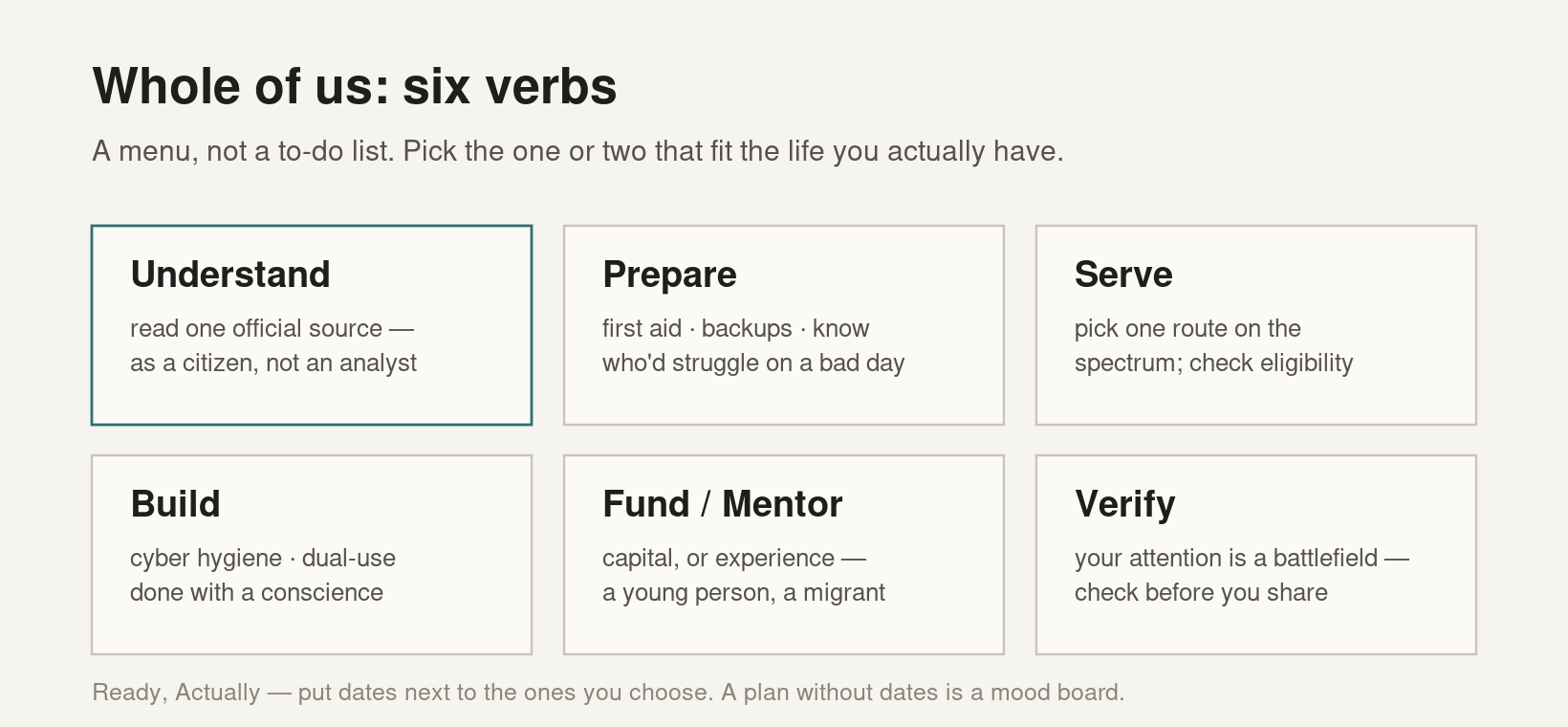
Figure 5 — Whole of us: the six verbs of the civilian field guide.
The student wondering whether any of this is “for” them: the cyber and technical routes were practically built for you, and the country is short of precisely the thing you already have or could quickly acquire.
The engineer who recoils at the word “defence”: the room needs your conscience far more than it needs your principled absence.
The founder: resilience is a market the size of a continent, and most of it is dual-use you could be genuinely proud of building.
The migrant (hello, one more time): you contribute your way in. Belonging is earned in the open, and it counts — passport or not, it counts.
The parent, the nurse, the driver, the neighbour: you are the social fabric — the layer that is cheapest to ignore, impossible to buy back in a hurry, and, when it holds, the thing that quietly defeats every plan to make a society panic and turn on itself.
I opened this book by promising it would not be a fear book, and I have tried to keep faith with that promise on every single page. So here is the ending, and it is not a warning. It is an invitation.
A porcupine is not brave, and it is not aggressive, and it does not lie awake afraid. It simply makes itself not worth the trouble, and then gets on with its quiet, unremarkable, entirely peaceful life. That is the whole ambition of this book, scaled up to a country: a Britain so calmly, so distributedly, so boringly hard to frighten, to divide, and to switch off that the question of attacking it never makes it past the first meeting in whatever grim room such questions get asked. And here is the secret the strategy documents say in careful committee language and I will say in plain English one final time: most of those quills are not soldiers. They are nurses who know the plan when the screens go dark. Engineers who took the security update seriously. Neighbours who notice. Founders who built the useful thing instead of the cynical one. Reservists whose employers understand why it matters. Kids who learned, on a ridiculous hill in Gloucestershire, that the trick is not to avoid falling but to fall well and roll back up.
It is, in the end, whole of us. Including — if you’ll have me, and I know the asking is its own small act of nerve — the Russian who looked hard at this country, decided it was worth the trouble, and chose to help caulk the boat he’d boarded rather than admire it from the safety of the shore.
You don’t have to be afraid. You don’t have to be a hero. You just have to be ready.
Ready, actually.
Public sources used in this edition, grouped by theme. All URLs were live at the time of writing; recency should be re-checked before each public release. Where a claim in the text carries an evidence grade, it traces to a source in this list or to the linked official document.
Strategic Defence Review 2025, Making Britain Safer: secure at home, strong abroad — GOV.UK: https://www.gov.uk/government/publications/the-strategic-defence-review-2025-making-britain-safer-secure-at-home-strong-abroad
Strategic Defence Review 2025 — House of Lords Library: https://lordslibrary.parliament.uk/strategic-defence-review-2025/
“The 2025 Strategic Defence Review: five unanswered questions” — UK in a Changing Europe: https://ukandeu.ac.uk/the-2025-strategic-defence-review-five-unanswered-questions/
“From Strategy to Stall? … the Emerging Implementation Gap” — Royal Aeronautical Society: https://www.aerosociety.com/news/from-strategy-to-stall-the-uk-s-strategic-defence-review-and-the-emerging-implementation-gap/
“The Strategic Defence Review 2025: a troubling step towards perpetual militarisation?” (dissent) — AOAV: https://aoav.org.uk/2025/the-strategic-defence-review-2025-a-troubling-step-towards-perpetual-militarisation/
National Security Strategy 2025, Security for the British People in a Dangerous World — GOV.UK: https://www.gov.uk/government/publications/national-security-strategy-2025-security-for-the-british-people-in-a-dangerous-world
Defence Industrial Strategy 2025, Making Defence an Engine for Growth — GOV.UK: https://www.gov.uk/government/publications/defence-industrial-strategy-2025-making-defence-an-engine-for-growth
UK Government Resilience Action Plan — GOV.UK: https://www.gov.uk/government/publications/uk-government-resilience-action-plan
GOV.UK / Prepare (household preparedness): https://prepare.campaign.gov.uk/
Quarterly service personnel statistics: 1 January 2026 — GOV.UK: https://www.gov.uk/government/statistics/quarterly-service-personnel-statistics-2026/quarterly-service-personnel-statistics-1-january-2026
UK Public Survey of Risk Perception, Resilience and Preparedness 2025 — GOV.UK: https://www.gov.uk/government/statistics/uk-public-survey-of-risk-perception-resilience-and-preparedness-2025
Conscription and national service in the UK — House of Commons Library (CBP-10226): https://commonslibrary.parliament.uk/research-briefings/cbp-10226/
“Conscription in the UK: A National Disservice?” — RUSI: https://www.rusi.org/explore-our-research/publications/commentary/conscription-uk-national-disservice
“You Belong Here” — British Army: https://www.army.mod.uk/news/you-belong-here-says-latest-british-army-recruitment-campaign/ ; analysis: https://www.campaignlive.co.uk/article/british-army-ad-shows-potential-new-recruits-belong/1890147
Royal Navy careers / “Made in the Royal Navy”: https://www.royalnavy.mod.uk/careers ; https://www.thedrum.com/news/royal-navy-launches-new-recruitment-campaign-made-royal-navy
Metropolitan Police “Change Needs You”: https://www.met.police.uk/police-forces/metropolitan-police/areas/about-us/about-the-met/campaigns/change-needs-you-recruitment-campaign/ ; Detective direct entry: https://www.met.police.uk/news/met/met-launches-new-detective-recruitment-campaign/
Nationality & immigration requirements for the UK armed forces — House of Commons Library (CBP-8625): https://commonslibrary.parliament.uk/research-briefings/cbp-8625/ ; Army nationality guidance: https://jobs.army.mod.uk/how-to-join/can-i-apply/nationality/
Cyber Direct Entry scheme — GOV.UK: https://www.gov.uk/guidance/cyber-direct-entry-scheme
Recruitment reform (pay rise, policies, Gap Year) — GOV.UK: https://www.gov.uk/government/news/armed-forces-careers-unlocked-for-tens-of-thousands-through-new-recruitment-drive
UK Defence Innovation (UKDI) — launch & remit: MOD/techUK announcement (1 July 2025); analysis — RUSI: https://www.rusi.org/explore-our-research/publications/commentary/same-same-different-launching-uk-defence-innovation ; first-year drone/counter-drone funding: https://defensehere.com/uk-launches-ps140m-push-for-uncrewed-and-counter-drone-technologies-in-1st-year-of-ukdi
Defence and Security Accelerator (DASA) — GOV.UK: https://www.gov.uk/government/organisations/defence-and-security-accelerator
NATO DIANA: https://www.diana.nato.int/
National Security Strategic Investment Fund (NSSIF) — British Business Bank: https://www.british-business-bank.co.uk/finance-options/equity-finance/national-security-strategic-investment-fund
UK defence-tech investment & inbound firms (Helsing, Tekever, Anduril): https://sifted.eu/articles/european-defence-tech-startups-uk-expansion ; https://www.cnbc.com/2025/12/11/ai-defense-boom-in-uk-and-germany-as-new-wave-of-companies-emerge.html ; https://www.defensenews.com/industry/2026/01/20/defense-tech-startups-had-their-best-funding-year-ever-in-2025/
White Paper for European Defence – Readiness 2030 & ReArm Europe — European Commission: https://defence-industry-space.ec.europa.eu/eu-defence-industry/white-paper-european-defence-readiness-2030_en
“Safer Together” (Niinistö report on civil & military preparedness) — European Commission: https://commission.europa.eu/topics/defence/safer-together-path-towards-fully-prepared-union_en
Mykhailo Fedorov appointed Minister of Defence (14 Jan 2026) — Ministry of Defence of Ukraine: https://mod.gov.ua/en/news/mykhailo-fedorov-appointed-as-ukraine-s-new-minister-of-defence
Brave1 defence-tech cluster: https://ukrainesarmsmonitor.substack.com/p/brave1-the-engine-behind-ukraines
Ukraine defence-tech funding 2025: https://united24media.com/war-in-ukraine/ukraines-defense-tech-boom-129m-raised-in-2025-2x-growth-over-2024-15656
“Drone superpower: Ukrainian wartime innovation offers lessons for NATO” — Atlantic Council: https://www.atlanticcouncil.org/blogs/ukrainealert/drone-superpower-ukrainian-wartime-innovation-offers-lessons-for-nato/
Code4000 (prison coding) — GOV.UK: https://www.gov.uk/government/news/coding-to-be-taught-in-prison-to-help-offenders-return-to-the-world-of-work ; outcomes: https://justice-trends.press/code4000-a-prison-project-that-yields-tech-jobs-to-prisoners/
TechVets (Forces Employment Charity): https://www.forcesemployment.org.uk/programmes/techvets/ ; https://www.gov.uk/government/news/rfea-and-techvets-are-bridging-the-gap-for-veterans-entering-cyber-and-technology-industry
Foreign Influence Registration Scheme (FIRS) — GOV.UK collection: https://www.gov.uk/government/collections/foreign-influence-registration-scheme
Whole-of-society resilience — the doctrine, now official UK policy, that a modern society (not only its armed forces) is part of the security system; staying functional under pressure is a shared task.
Deterrence / the Porcupine Principle — making aggression unattractive rather than promising to win a fight. A porcupine attacks no one but is not worth eating. The book’s organising metaphor for readiness-as-peace.
Dual-use — technology with both civilian and defence applications (e.g., drones, cyber tools, AI, robotics). The moral weight lies in use, customer, governance, and oversight — not in the label.
The four layers — the book’s recurring map of national readiness: the shield (forces, intelligence, alliances, police, emergency services); the nervous system (cyber, telecoms, payments, data, software); the bloodstream (energy, food, water, transport, health, money); and the social fabric (trust, skills, shared reality, neighbourliness).
SDR 2025 — Strategic Defence Review 2025; 62 recommendations, “NATO First,” whole-of-society resilience, a spending path toward higher GDP shares.
NSS 2025 — National Security Strategy 2025, Security for the British People in a Dangerous World; frames security beyond the military and references a 5%-of-GDP NATO pledge.
DIS 2025 — Defence Industrial Strategy 2025, Making Defence an Engine for Growth; treats defence as a growth/jobs engine; creates a National Armaments Director.
UKDI — UK Defence Innovation; MOD innovation body launched 1 July 2025 with a £400m ring-fenced annual budget, consolidating DASA and other units.
DASA — Defence and Security Accelerator; finds and funds exploitable defence/security innovation (now within UKDI).
NATO DIANA — Defence Innovation Accelerator for the North Atlantic; NATO-wide accelerator offering grants (≈€100k, with follow-on up to ≈€300k); open beyond UK nationals by design.
NSSIF — National Security Strategic Investment Fund; the UK government-backed venture investor (via the British Business Bank).
Defence Readiness Bill — proposed legislation to let government mobilise industry and reserves if a crisis escalates.
Reserves / cadets / special constabulary — part-time and volunteer routes into the armed forces and policing that let people serve without leaving civilian life.
Brave1 — Ukraine’s state-backed defence-technology cluster (grants + a procurement marketplace) that helped scale the country’s drone ecosystem.
Diia — Ukraine’s flagship digital public-services and identity platform; cited as an example of a civic interface that became a resilience asset in wartime.
Army of Drones — Ukrainian state programme that pays manufacturers and units for confirmed battlefield effects, feeding frontline data back into design.
FIRS — Foreign Influence Registration Scheme; UK regime requiring registration of certain activities carried out for specified foreign powers. This book takes no view on any individual’s status and points readers to official guidance.
This is a work of public-source civic education. It is not operational defence advice, tactical guidance, weapons instruction, or adversarial tradecraft, and it contains none of those things.
No operational detail. Nothing here is intended to help anyone do harm. Where a topic could tip into operational territory, the book stops at the level of public understanding.
Eligibility is not advice. Rules for service, grants, clearance, and programmes change, vary by role and nationality, and are decided by the relevant authority — never by a book. Always verify on the official page before acting.
On the law (including FIRS). The book explains that relevant legal regimes exist — the Foreign Influence Registration Scheme came into force on 1 July 2025, under the National Security Act 2023 — and points to official guidance. It does not tell any reader what they personally do or do not need to do under any scheme. For your own position, consult the official sources or a qualified adviser.
Evidence labels. Fact = grounded in checked public sources; Inference = the author’s reasoned interpretation; Recommendation = a proposed action. Confidence tags: [Strongly evidenced], [Moderately evidenced], [Weakly inferred].
If anything in here reads as fear-mongering, division, or enthusiasm for conflict, it is a failure of execution, not intent — and feedback is welcome.
Some of what this book points to will be out of date before the ink is dry. Routes open and close, grant deadlines pass, eligibility rules shift, and whole funding bodies reorganise (UK Defence Innovation alone absorbed several older units in 2025). Print can carry the argument; it cannot carry the calendar.
So the live, dated, checkable version of the practical material lives online, at defence.is - the companion tracks the things that move:
UK Defence Innovation (UKDI) — open calls and competitions.
NATO DIANA — deadlines and eligibility.
NSSIF — portfolio focus and investment criteria.
Commonwealth / non-UK armed-forces eligibility — current rules, by service.
Volunteer routes — reserves, the special constabulary, the RNLI, community first responders, and how to start.
FIRS — links to the current official guidance.
The book is the part that should still make sense in five years: the frame, the metaphors, the questions. The web is the part that has to be right this week. Trust the book for the why, and the companion for the where and when — and, as ever, verify the official page before you act on either. That division of labour isn’t a compromise; it’s the point. A book that tried to be a database would be wrong by its second printing, and a database can’t teach you to long for the sea.
Britain doesn’t need another panic book. It needs a clearer map.
Ready, Actually is a civilian’s field guide to a country quietly changing what it expects of itself — written, with some irony, by a Russian-born Londoner who left the threat, chose Britain, and would like to help.
It explains Britain’s new security age without militarism, jargon, or theatrical doom: why “whole-of-society” keeps appearing in official documents; why the recruitment problem is really a meaning problem; what Ukraine can teach democracies about adapting; why dual-use technology stops being scary once you understand it; and how preparation can widen belonging instead of spreading fear.
The point is not to want war. The point is to be the porcupine — so calmly, boringly hard to frighten, divide, and switch off that the fight never comes.
You don’t have to be afraid. You don’t have to be a hero. You just have to be ready.
Ready, actually.